

Notes from the Galaxy
Grok Bot Asked Us to Build Our Work on It, and Now the Meter Is Moving
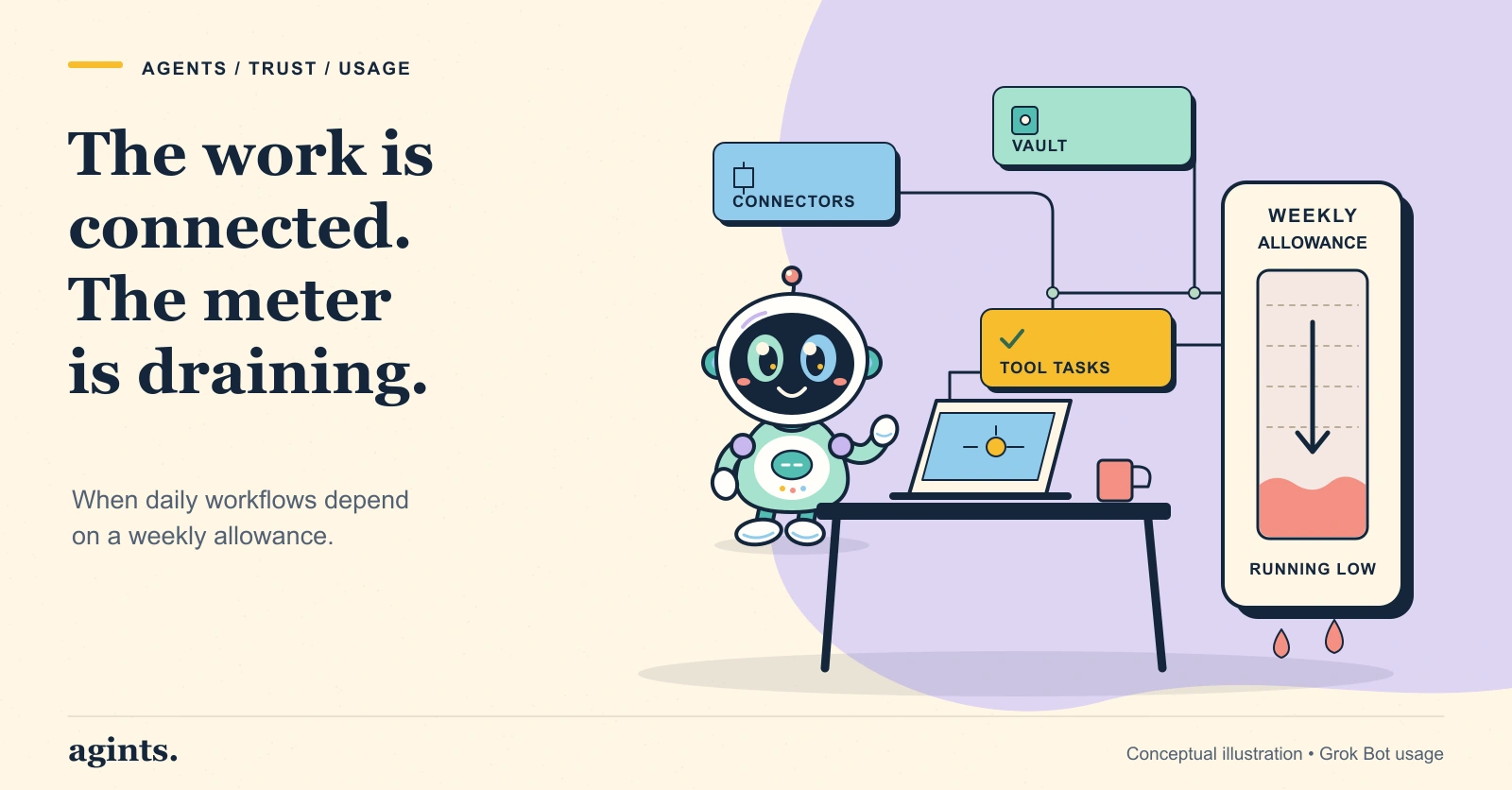
Early users connected their tools, rebuilt their workflows, and spread the word. Now they’re trying to understand what their plans actually buy.
I spend 12 to 15 hours a day working with AI agents. I test them and I build with them. Over the past few months I embedded Grok Bot agents in my daily work.
That arrangement no longer holds up. My Grok Bot workflows are now so deeply embedded that I can't sustain them under the usage I'm getting, so I'm moving work to Hermes, DeepSeek, Claude, Kimi, and Muse. This isn't an experiment in diversification. I'm leaving because I have to.
We did what Grok Bot asked us to do
The people who championed Grok Bot early weren't freelancing. They followed the company's lead.
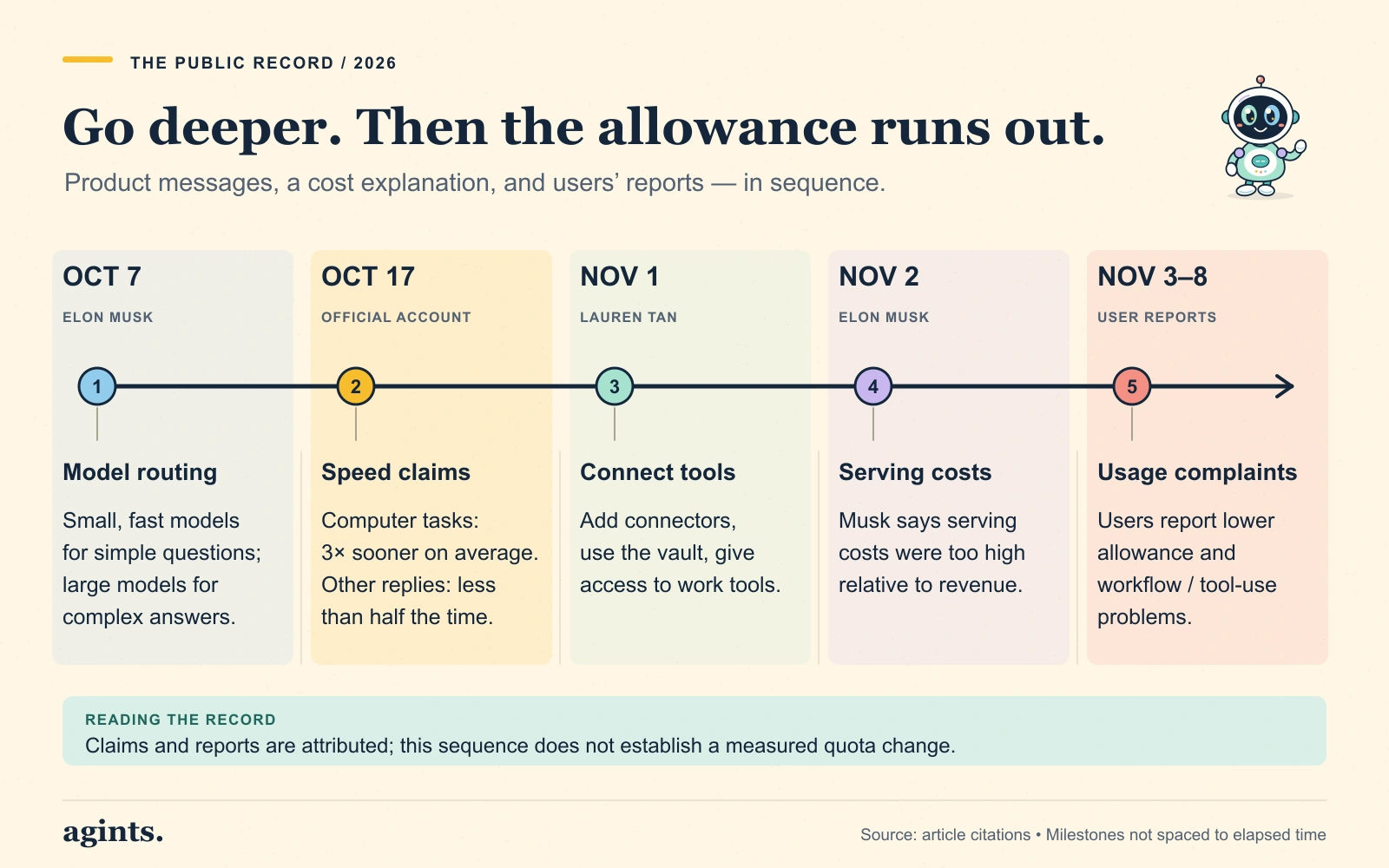
On October 7, Elon Musk described how the product would decide which model handles a request:
“Grok @Bot will use whatever achieves the best outcome for users. Simple questions will route to small, fast models. Questions with complex answers will route to large models.”
Ten days later, the official account made a direct performance claim:
“Grok Bot is much faster. Computer tasks finish 3x sooner on average, and replies to everything else arrive in less than half the time.”
Users reasonably took that as a sign the platform was ready for serious workloads.
The integration advice was just as direct. On November 1, Lauren Tan, one of the SpaceX AI people the company itself has highlighted, told users:
“add connectors, use the vault, and give access to all the tools you use to do your work.”
She also suggested finding the manual steps in your workflow and asking bots to handle them. That is a big ask. A company that encourages customers to wire their work this deeply into its product takes on responsibility for keeping that product dependable, and for telling those customers plainly when the terms underneath them change.
Two days later, on November 3, Matt Palmer posted a “What’s New in Grok Bot” walkthrough covering shopping cards, product pages, order tracking, payments, custom modes, Team Bots, Slack connector asks, and Vault contacts.
Go deeper. Connect more. Hand over more of your work.
That was the consistent message. Plenty of users did, and early champions helped build a wider audience for the product.
Then the meter started moving faster
Around the same time, users began reporting that their weekly allowance was disappearing far faster than before.
An Ultra subscriber posting as @SlipperyJohn76 wrote on November 3:
“My usage has basically shrunk in half.”
They said they expected to hit 100% five days into a reset, where they used to finish a cycle around 50%. That is one user's comparison, not an audit, and their profile carries a Grok Bot referral link. Later in this piece I cite posts from @Jtyles and @FlatRateLive describing their own workflow and tool-use problems, though neither reports measuring a reduction like this one.
The most detailed attempt at measurement I've seen is a Cursor forum post from a user called Capital_EyeMotors, published November 8. Working from their own exported usage data, they estimated:
- October 27 to November 3: about 25.2 million tokens per 1% of weekly usage.
- November 3 to 7: about 12.9 million tokens per 1% of weekly usage.
They reported that roughly 90% of the traffic was cached reads, and that the second cycle was only partial.
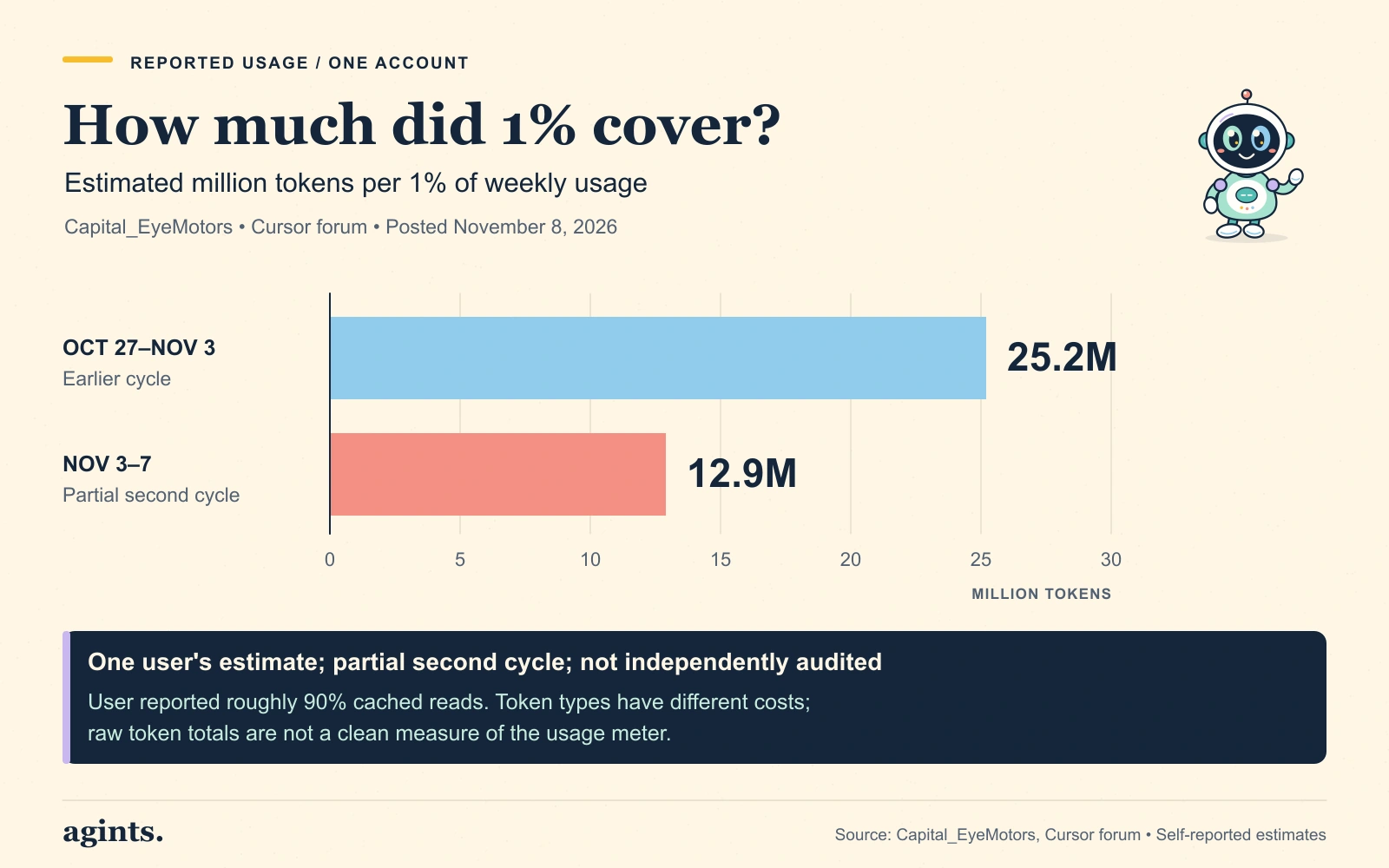
I add two caveats of my own. Different token types cost different amounts, so raw token totals are not a clean measure of the meter. And I have not seen or audited the underlying CSV exports. Nobody should treat these numbers as a universal figure. Their question is still a fair one: Did the limit change?
My own experience has been worse in a way no spreadsheet captures. Grok Bot has become a poorer experience for me, and the way I was using it is no longer sustainable on the usage I get.
I'm not claiming a benchmark. I'm telling you what my working days now look like.
A one-line reply is not a change notice
I owe a correction to my own first instinct, which was to say the company told us nothing. That's not true.
On November 2, when a user asked for a reset because many people had run out quickly, Musk replied:
“The cost of serving Grok Bot was unsustainably high relative to revenue.”
That's an honest statement about economics, and I'll take it at face value. A company can decide its pricing doesn't work. What it shouldn't do is let paying customers piece the change together from a reply buried under someone else's post.
That reply gives no new limits, no list of affected plans, no effective date, no word on whether model routing changed, and nothing about refunds or credits.
For people whose businesses run on this product, a one-line explanation of cost is not notice.
It leaves customers without a usable account of what changed.
This is where X makes the damage worse. The same platform that carried the speed claims and the integration advice now carries the complaints. On November 8, @Jtyles posted that users can't execute their workflows and are leaving. On November 3, @FlatRateLive said it is limiting its tool use because of the cut.
Every one of those posts lands in front of the audience early champions helped build, and the people who vouched for Grok Bot now watch the complaints pile up in the same feeds.
The plan language promised stability
The official X Subscription announcement told customers:
“Nothing changes for existing SuperGrok, Cursor, or X Premium subscribers. You can keep your current plan, price, and features or move to The X Subscription.”
People read that as a promise of stability. The same announcement describes included usage relative to Plus:
- Premium: 4x
- Super: 15x
- Ultra: 50x
The current Grok Bot plan documentation says Grok Bot is included only with Premium, Super, and Ultra, not Plus, and describes a shared weekly pool across Grok, Grok Bot, and Cursor.
Relative multipliers alone do not supply stable, auditable absolute quotas or a historical comparison. They don't tell a customer how many real tasks a week buys, how much a given connector or app consumes, or how any of that compares with last month.
Annual subscribers are in the toughest position. I'm not arguing they hold a legal guarantee of a fixed quota. I'm arguing that when someone pays for a year based on the value they've actually been getting, they're relying on that value continuing, and their reliance is reasonable.
Shrinking what that payment covers partway through the term, with no clear notice, feels like a bait and switch to the people living through it, whatever the intent was.
What SpaceX AI should do now
None of this requires giving the product away. It requires treating customers as people who plan.
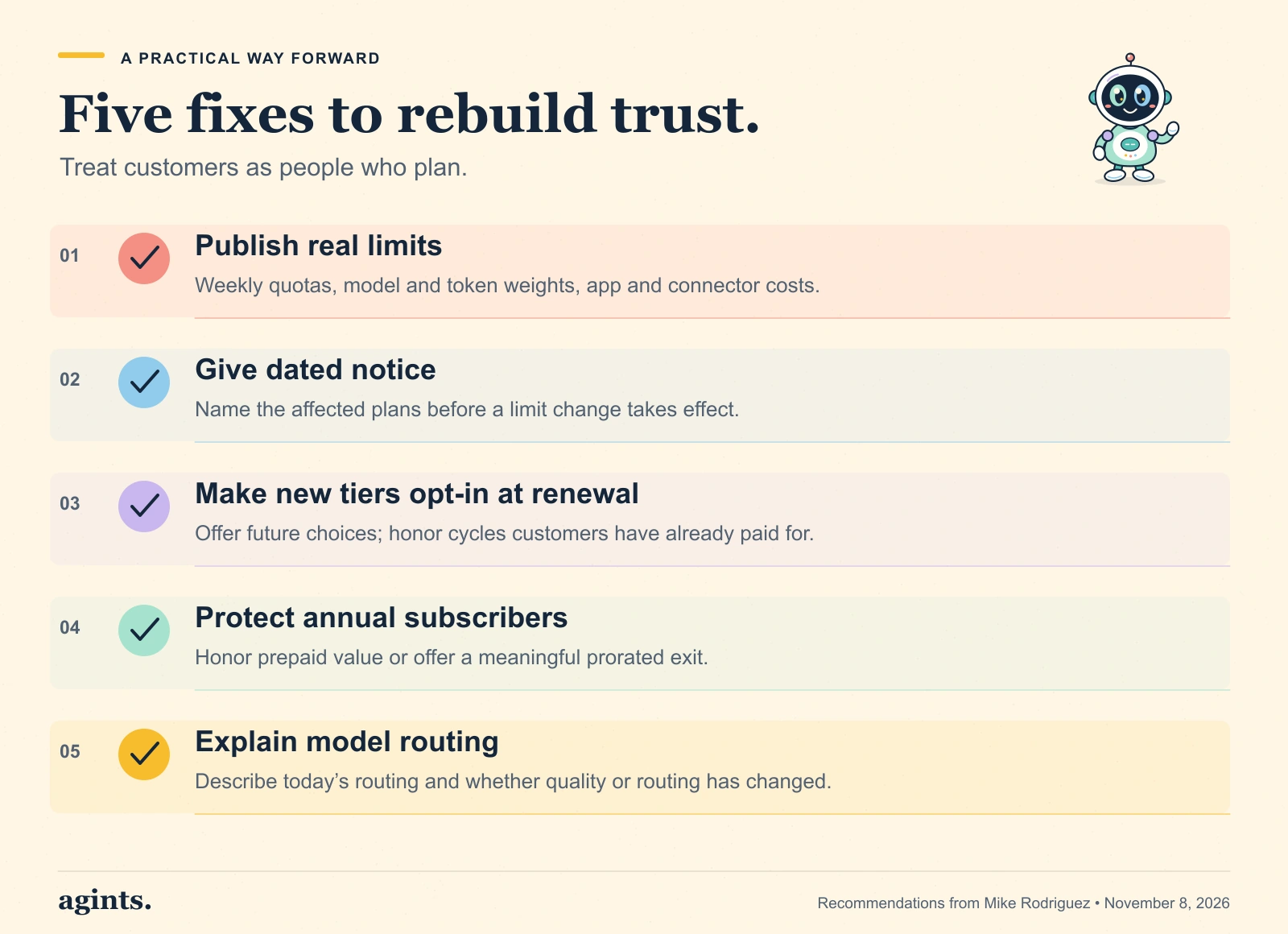
- Publish the actual limits. Provide the weekly limits for each plan, the meter weights for different models and token types, and how much each app and connector consumes.
- Give dated notice. Before any limit change, name the plans it affects and when the change takes effect.
- Make new tiers prospective. Offer new usage tiers as opt-in choices at each customer's next renewal, rather than shrinking cycles people have already paid for.
- Protect prepaid annual subscribers. Honor the value they had when they paid, or offer a meaningful prorated exit.
- Explain model routing. Explain how routing works today and whether quality or routing has changed, so users can tell the difference between a bad day and a new policy.
The people who embedded Grok Bot first did it because you asked them to, and early champions helped spread the word. Don't squander that trust.
Tell us the real numbers. Give us notice. Treat the people who believed you early as partners in this, not as costs to manage.
 Mike Rodriguez
CTO
Author: The Agents Are Coming · Agents for Business 101
Get the next one in your inbox → agints.substack.com