

Notes from the Galaxy
Why China Has an Advantage in the AI Wars
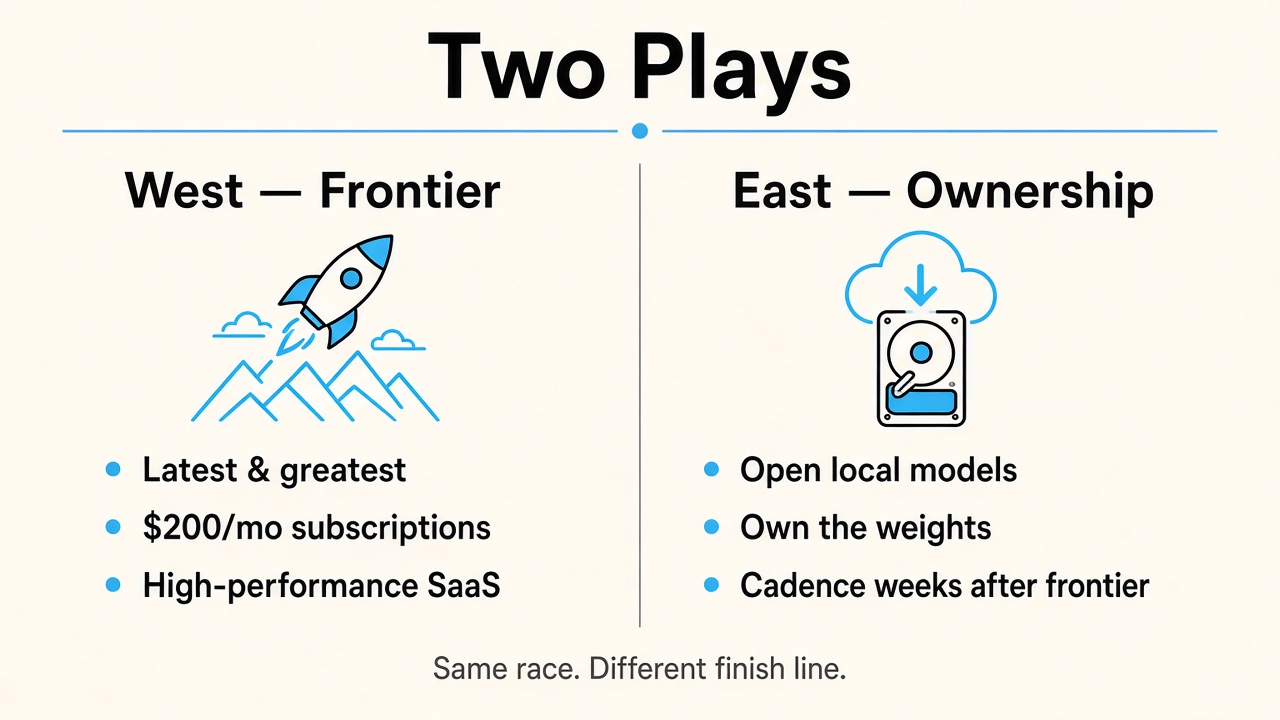
AI right now looks a lot like world politics.
In the West, the AI game is mostly frontier models — aimed at high-performance users who want the latest and greatest tools to build software that should, eventually, turn into profitable commercial products.
In the East, you have models that are [probably government-subsidized — we don’t know, because the books aren’t open] coming out increasingly as open source.
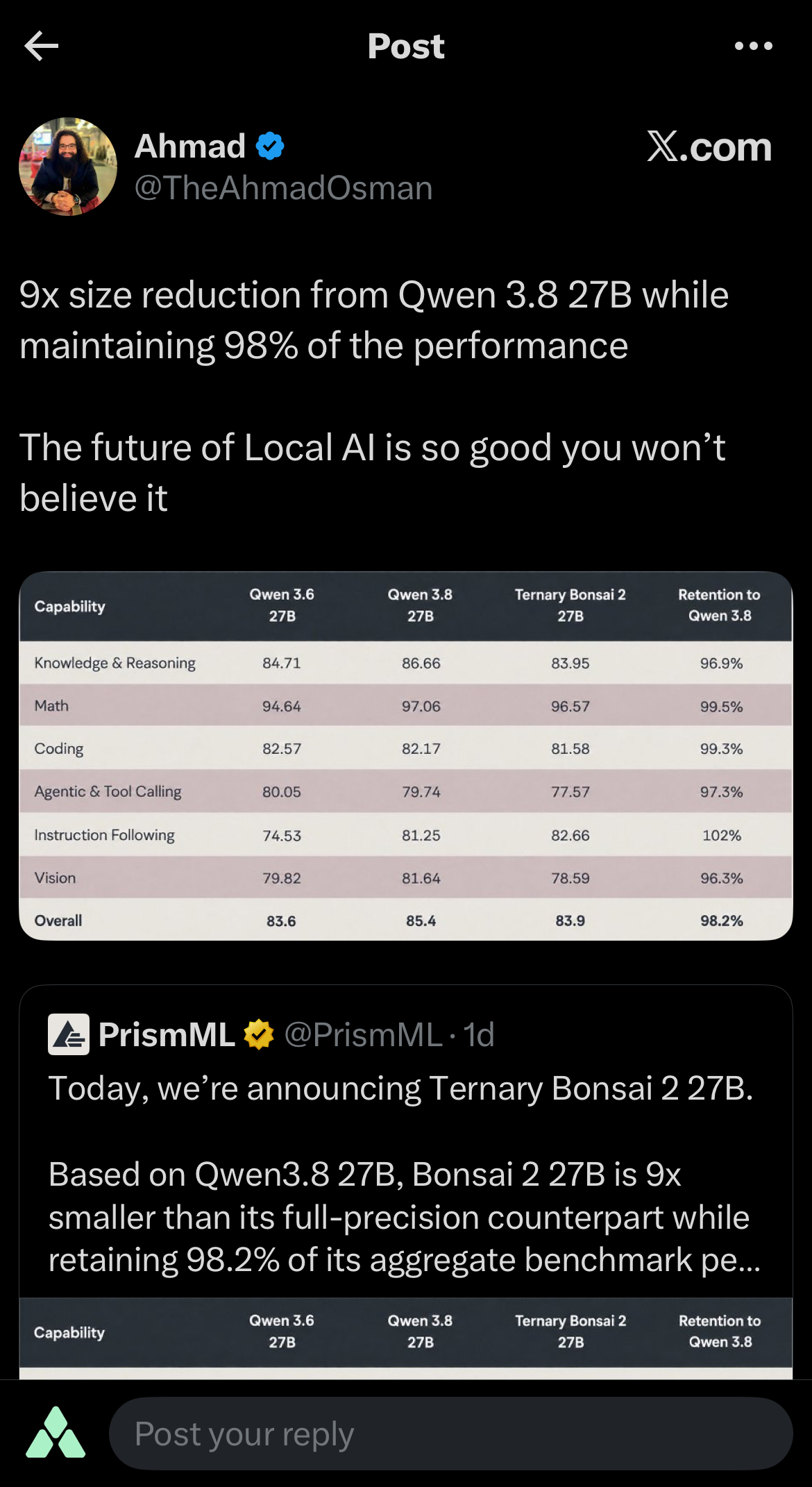
I woke up to the latest local-AI milestone in that lane: Alibaba’s Qwen3.8-27B open weights, and the compress wave riding on top of them.
That’s why this piece exists. Along the roadmap of local AI, this is one of those moments that will stand out as notable.
The model that wasn’t special — until it was
The previous release wasn’t anything special.
On a very fast local computer — something very few people have — it was at best a decent chatbot. In reality, it could not handle multi-step tasks without derailing. Fine for chat. Not fine for productivity.
Most people wrote it off. Another gap between Chinese models and the U.S. AI race.
Then Alibaba put Qwen3.8-27B into the open-weight lane — a 27B multimodal model built to run on consumer hardware. The sharper footprint story landed next: PrismML’s Ternary Bonsai 2 27B, derived from that Qwen base, claims a ~9× smaller memory footprint — about 5.9 GB — while retaining ~98% of the full-precision benchmark score (PrismML’s numbers; not an independent audit).
So now you have a mildly performant 27B-class model that can sit on a normal machine.
And the math is clear.
If we play this game out long enough, we may not see true frontier models out of China’s open-source world. What we will see are models that are almost frontier — releasing at a cadence of probably a few weeks after the frontier model drops — without the cost, and with a lot of the ownership people actually want.
Reasons people care about that ownership: censorship. Equity in their own future. A model you can lean on to build a business. A model you can lean on to educate yourself.
That’s important to a lot of people in the world.
Maybe not in the U.S. — where the focus is “what’s the latest and greatest from the big five.” And that, I think, is keeping the West blind to the business model China is running.
Why China might win long term: the economics don’t add up for frontier subscriptions
Shift to the long game.
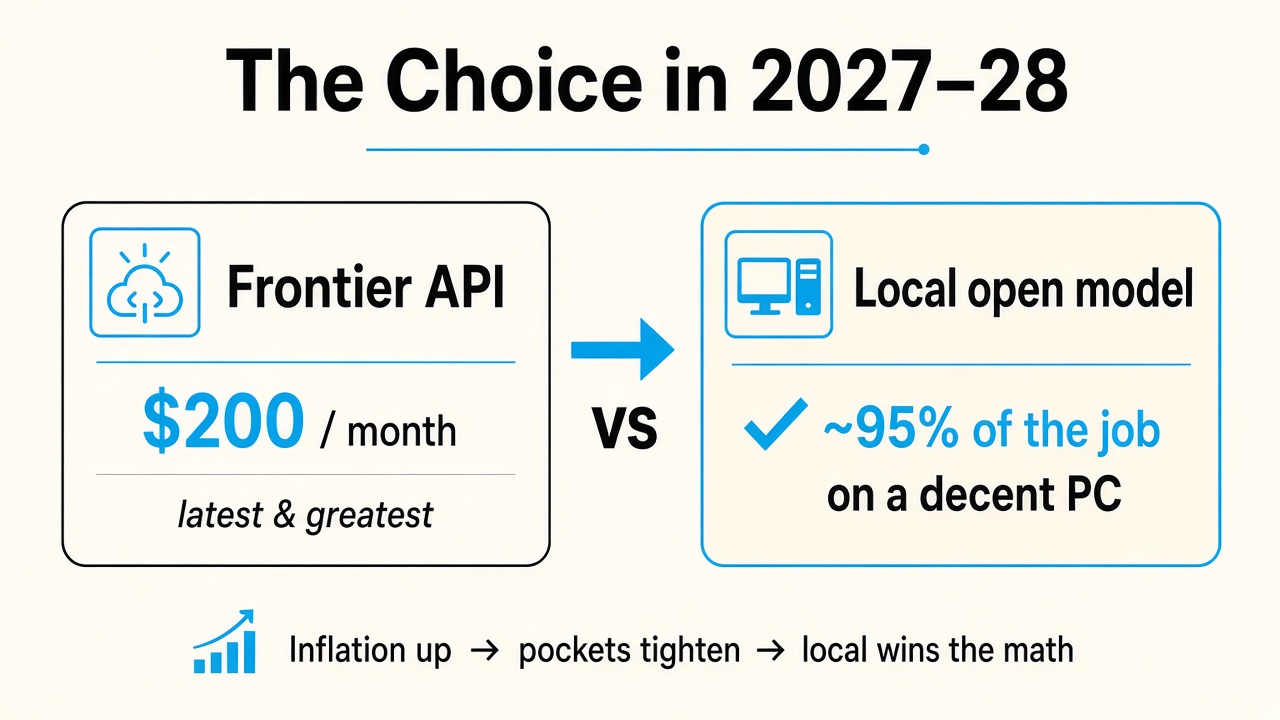
If someone in 2027 or 2028 has to choose — latest-and-greatest model for $200 a month, or something that does ~95% of that job sitting on a decent computer from the last two or three years — the math points to buying the machine and downloading the model.
In one to two years, multi-step tasks get handled by local models. They will be able to do what the latest Grok Bot and the latest Codex can do today.
That’s a highly probable path.
As the majority of users realize those economics favor local compute + local models, that erodes the revenue pouring into OpenAI, Grok, Claude, Meta’s new product pushes, and Google — because it simply doesn’t make sense in a world where inflation keeps running hot.
Bond yields are rising to levels we haven’t seen in a very long time. That’s signaling inflation ahead. When inflation’s ahead macroeconomically, people tighten their pockets. Businesses tighten their pockets. Local AI is the escape hatch: capable models that don’t eat your whole machine and still deliver 90–95% of frontier performance.
The Qwen → Bonsai footprint collapse is an important milestone on that roadmap. Almost 10× decrease in size while keeping most of the measured performance — if the vendor numbers hold.
Do that type of advancement two or three more times over the next 12 to 18 months, and the math puts multi-step orchestration on local compute.
If that’s the case, only a few fringe outlier cases still demand frontier-model engineering.
In 12 to 18 months, local AI is going to build your website. More than likely the software behind it. More than likely the entire platform behind it. Daily internal workflows. External workflows too — marketing, ads, creative, lead CRM. Getting someone from point A to point D on your lead pipe.
All of that.
The narrowing gap — and a claim I can’t prove
It seems China has a very good way of taking the newest frontier models, bringing them into the shop, tearing them apart, and rebuilding / repackaging them as open source.
I am not able to corroborate that with hard evidence.
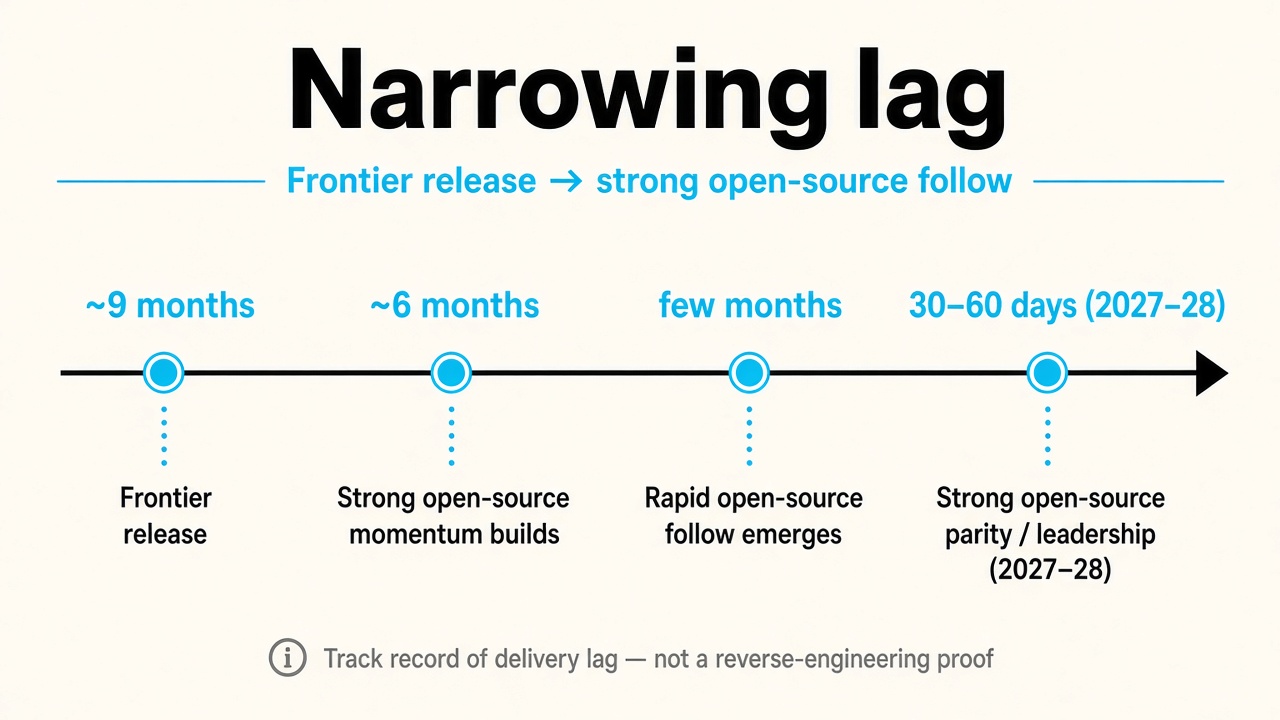
What I can see is the track record on delivery lag:
- Frontier models used to be about nine months ahead of local compute delivery.
- Then it looked like about six months.
- Now the advantage is dropping to a few months — meaning if a frontier model launches in July 2026, you might see something very similar creep onto the market by October 2026.
With that cadence — and with the quality/performance gap narrowing — by 2027–2028 we’re more than likely looking at frontier releases followed 30 to 60 days later by a strong open-source alternative out of a Chinese model house.
How does AI infrastructure handle that?
How does the American AI company business model handle that?
I don’t know how OpenAI substantiates its model on quarterly calls. I don’t know how it works with investors for Claude. But it will be known once Anthropic goes public in the next few months — and my read is that IPO timing may signal they don’t trust the business model beyond the next six to twelve months.
Another hit.
Am I just throwing darts at a board? I am. But the pieces are lining up.
Attrition: who survives if local eats the stack
Same dart on the Anthropic IPO: the motive may be that they don’t know they can substantiate the business past that window.
SpaceX did something similar in the past few months: IPO at a high price, dipped, then slowly built back as people decided there was a future — even if they weren’t sure what it was. Elon lifted that story after the IPO with strong X product releases; xAI’s Grok Bot sits in that same Elon halo. Elon effect hovering over the IPO.
Does Claude have that Elon halo? Does Anthropic? Does OpenAI?
Do they have non-AI businesses?
Elon’s got Tesla. Starlink. Probably four or five others — including Boring — climbing in valuation.
I don’t see that for OpenAI. I don’t see that for Anthropic.
I do see it for Facebook, with the news product they just released. I see it with Google’s ecosystem. If Gemini doesn’t work well, they take a real big shot — a massive write-down on AI — but they don’t lose everything else. Last I checked, everybody still uses Gmail. Everybody still uses them for search. Heavy players without AI.
That means three out of the five in the American AI business have strong enough underlying businesses to survive even if AI falters with something like negative 30% revenue from local and open-source models.
Will Anthropic and OpenAI? I’m not sure they can.
This is a game of attrition.
How much capital can China throw at this — and for how long — before OpenAI and Anthropic collapse and leave Facebook, Google, and Elon with major AI market share?
And the bet beyond that: can the West keep throwing money at massive AI infrastructure while China spins up incredible models at zero cost that land on your computer and stay forever?
I don’t see a world where the AI investment math makes sense for the West in that frame.
I also don’t see a world where China can keep subsidizing these massive AI improvements without getting real revenue out of it — again, books closed, so this is a dart.
Are they secretly deploying AI to improve the overall economy? Maybe that’s the play. So far, I don’t see visible revenue generation out of the Kimi, Qwen, and DeepSeek houses of the world.
Maybe AI video is the play — spin up the models, people need AI video, revenue comes through the video portal. The U.S. doesn’t really have strong AI video models. Maybe that’s it.
I haven’t really looked at the revenue pipes — China keeps the books closed.
Video models, pain ahead, and no declared winner
But one can only assume that video models are how they make the money.
Give away the AI models. Let the world expand its use of AI. Naturally, AI video becomes a necessity — and they provide the AI video models.
That’s the only business model that makes sense in my mind when looking at Chinese models and why they give them away free and open source for your local computer.
Either way, I see pain ahead for OpenAI and Anthropic. I just don’t see how they substantiate a business on fringe enterprise users and the latest-and-greatest technical needs from SaaS companies — especially when local compute is getting so much better, so much faster.
Have I declared China the winner? No.
Do I see that every month that passes, China gets a little bit ahead in the race for who wins the next three to five years? Economically, there’s just no other way the argument forms for the West.
So that’s that — and I’m going back to building agents.
If you want a Chief-of-Staff agent installed for your business in about 90 minutes, that’s what we do at agints.com.
Thought of the day. I’ll review this at the end of the year and see, quarterly, whether the AI races have shifted in the West’s favor.
Mike Rodriguez, CTO