

Notes from the Galaxy
Web 2.0 on Notice
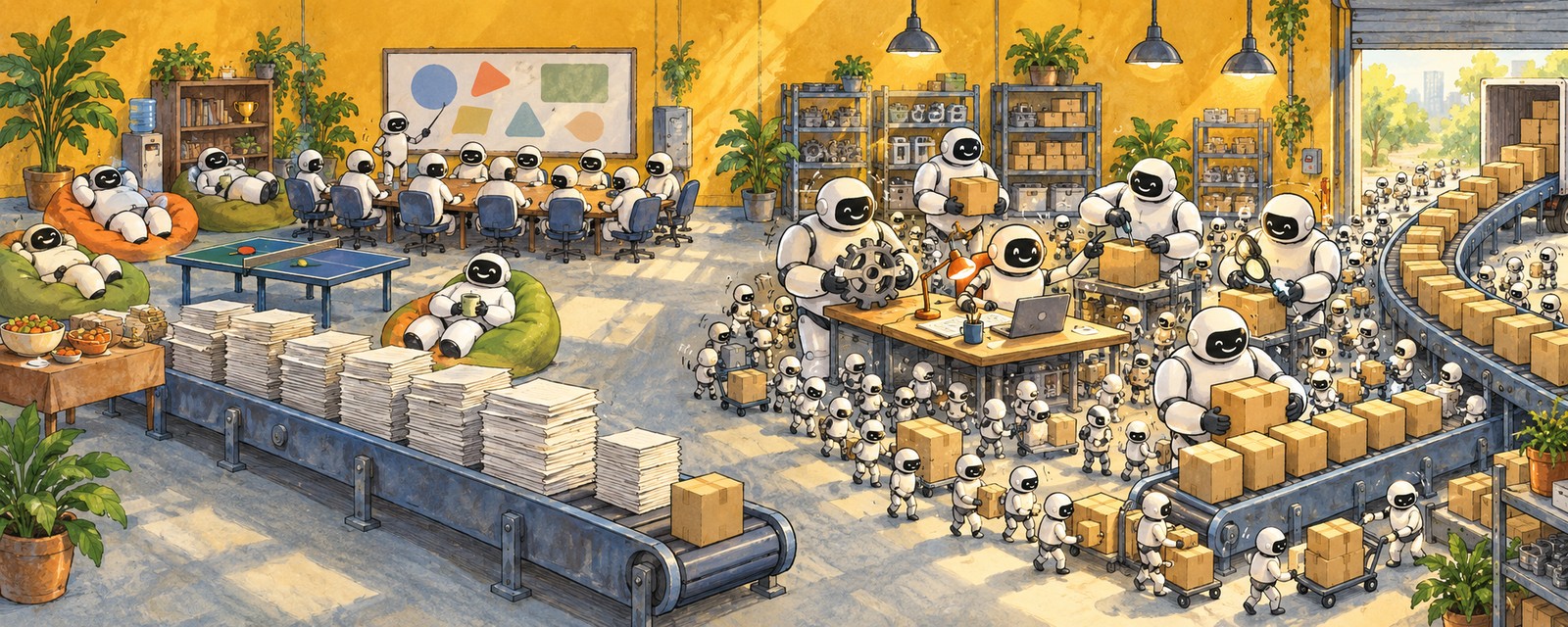
For twenty years, the safest job in tech was engineer at a Web 2.0 winner.
That safety is gone. And most of those companies haven’t noticed yet.
Today I want to talk about the difference between Web 2.0 companies and AI-driven companies.
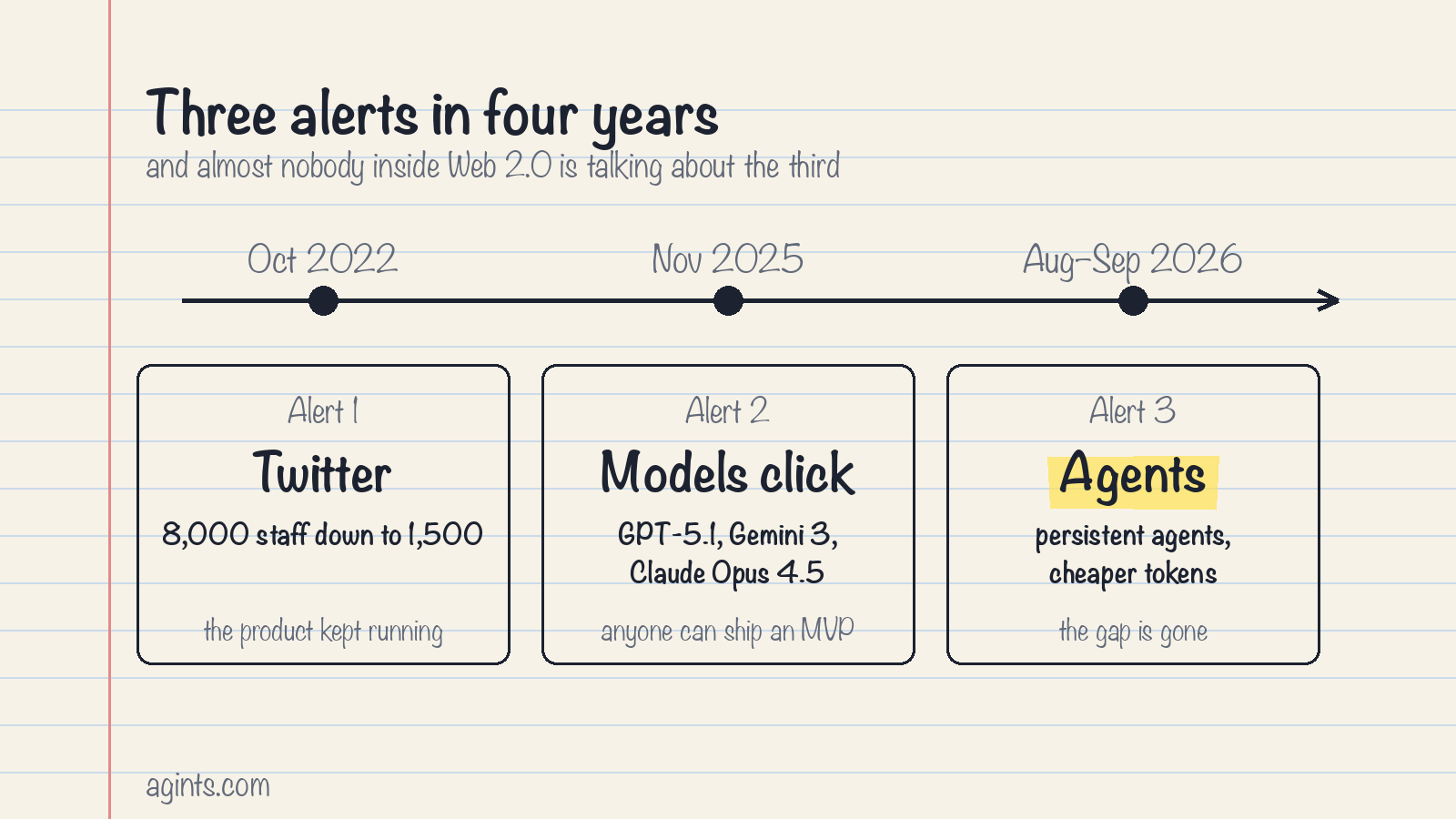
Three things happened in the last four years that put the old guard on notice. Almost nobody inside those companies is talking about the third one.
The comfort era
When I say Web 2.0, I mean companies like Dropbox, Netflix and Airbnb. They hit their stride somewhere between 2005 and 2025.
They had the capital. They raised well. Their engineering teams sat in comfortable offices and built without any real sense that a race was on.
The only race was the one created inside the building. By the board, the C-suite and the product managers.
That produced bloat.
These companies became honeypots. They attracted great talent, then wrapped it in bureaucracy and a culture that said: we have a good thing going, so why mess with it?
Why risk the free lunches and the perks of being an engineer at a big name?
Not every team wants to run flat out all week. So you get a don’t-rock-the-boat culture. And nothing tested that culture, short of a strange outlier event.
Alert one: Twitter
The outlier event came in late October 2022, when Elon Musk closed his $44 billion purchase of Twitter. That’s almost four years ago now.
Within months, the company went from just under 8,000 employees to about 1,500.
Roughly 80% of the staff was gone. And the product kept running.
His read was simple. Most of a giant Web 2.0 engineering workforce was not load-bearing. And if you were on the wrong side of that call, there was no mercy, because your track record was already written.
Here’s the part people forget. ChatGPT launched about a month after that deal closed.
Musk didn’t need AI to make those cuts. The bloat was visible without it. Then AI showed up right behind him.
Alert two: the models got good
Since then we’ve seen an explosion in model intelligence, and in the harnesses that point that intelligence at code.
The first wave of new builders had a rough time. They were working in early AI editors like Cursor and Windsurf, and they went through hell to ship anything.
Then, around November 2025, everything clicked. In about two weeks we got GPT-5.1, Gemini 3 with Google’s Antigravity, and Claude Opus 4.5.
Suddenly almost anyone could shape real software.
Rough, yes. But passable as an MVP. You no longer needed a computer science degree. You needed a handful of basics, the things I call the choke points of software development:
- How to use a repo
- Basic DevOps, so your app lives on a server with persistence and not just on your laptop
- A deployment platform like Vercel to carry the rest
Know those few things and you can steer a project far enough to get validation, raise money, or land paying customers for a micro-SaaS.
And that first revenue keeps you in the game as an AI developer.
The minnows
The Web 2.0 companies weren’t betting on that change. So they haven’t properly assessed how much the competition has surged in the last 18 to 24 months.
Right now there are people trying to take out Airbnb. People trying to take out Booking.com. People going after HubSpot and Salesforce.
Ninety-nine percent of them will fail to take down the whole monster. But they don’t have to. They only have to take a chunk.
Put enough minnows on the bait and they eat a real share of the meal the big sharks were counting on.
Alert three: agents
In the last two months, this threat went from growing to exploding. The reason is agents.
In August, Grok Bot arrived in beta. It showed how fast orchestration is moving: good product, good pull requests and usable software, at a speed we’ve never seen.
On September 8, Meta released Muse, a very capable agent. Three weeks later, on September 29, OpenAI answered with Dots. I’ve used Dots for the last few days. It’s capable, with some rough edges.
These agents are persistent. They don’t fall over like the rough agents from earlier this year, the OpenClaw and Hermes generation.
And tokens keep getting cheaper. Opus 5.5 launched on September 22 at 20% below the model it replaced.
So here’s the perfect storm.
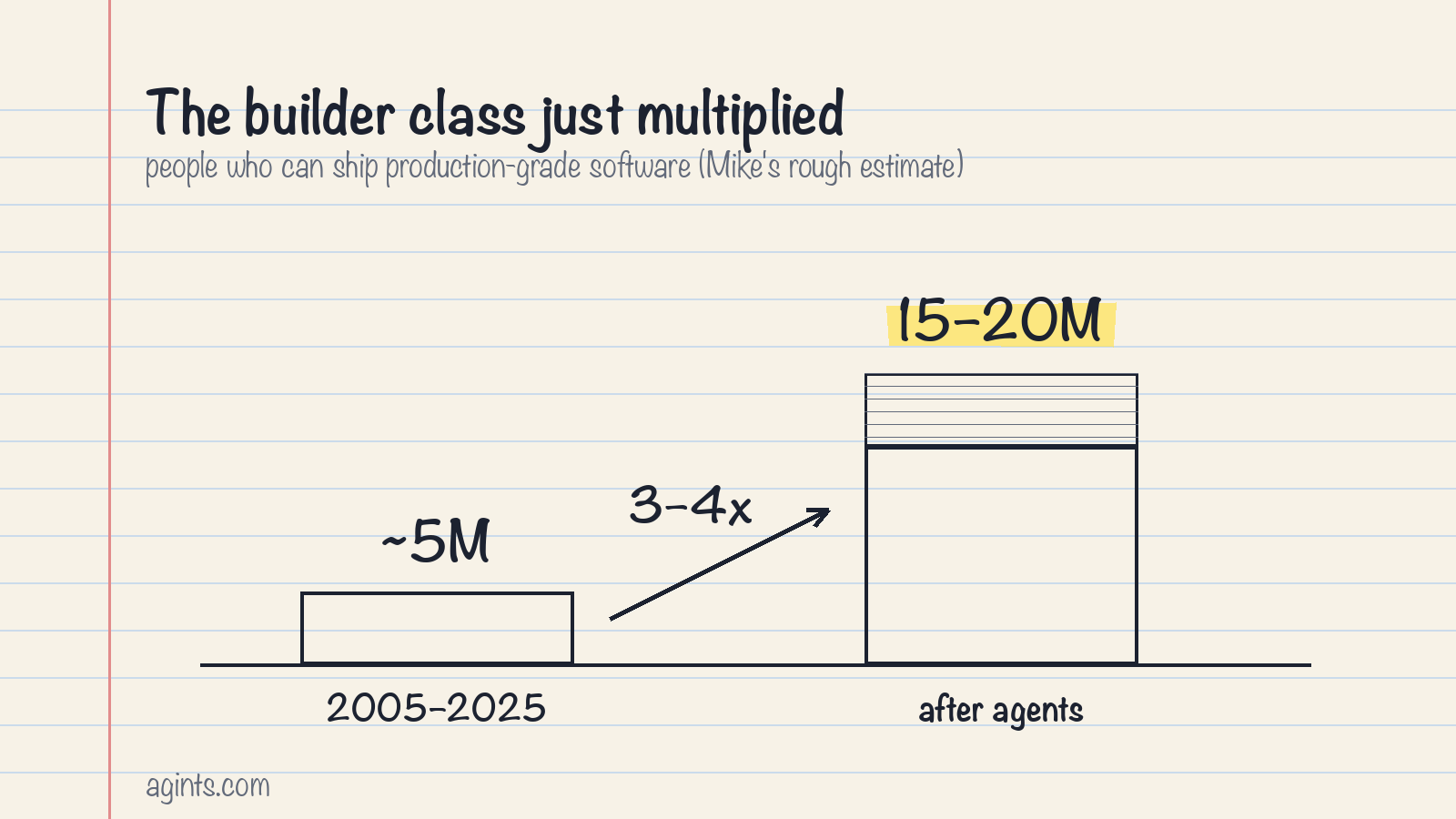
My rough number: from 2005 to 2025, maybe 5 million people worldwide could deliver a production-grade project. Every big company fought over them.
In the last three to six months, I think that number has grown three to four times.
Most of these new builders haven’t shipped anything that makes money yet. That’s only a function of time.
Because the moment one of them does, somebody else hears about it. What do you mean you vibe coded your way to an app that makes $2,000 a month? I want to know about that.
And the wave grows again.
Recap
So that’s three alerts in four years.
One: Musk showed that most of the comfortable software engineer class inside these companies could be cut.
Two: the models got good enough that someone with basic skills can launch products in micro-niches the big players used to own.
Three: agents and cheaper tokens are pulling in new builders every quarter. Each one hunting for a micro-SaaS that pays a few thousand a month, then a full-time income, then becomes a real company.
I don’t think Web 2.0 has properly assessed this. The culture still says: we’re so big that vibe coders will never be a threat, so business as usual.
I don’t hear it on investor calls. I don’t hear it in corporate meetings or in engineering circles inside these companies. They tend to assume their title still marks a gap in capability.
The gap is gone
Here’s what they haven’t realized. In the last 30 to 60 days, AI agents closed that gap.
Before, there was a comfortable buffer between a big-company engineering team and the aspiring vibe coder.
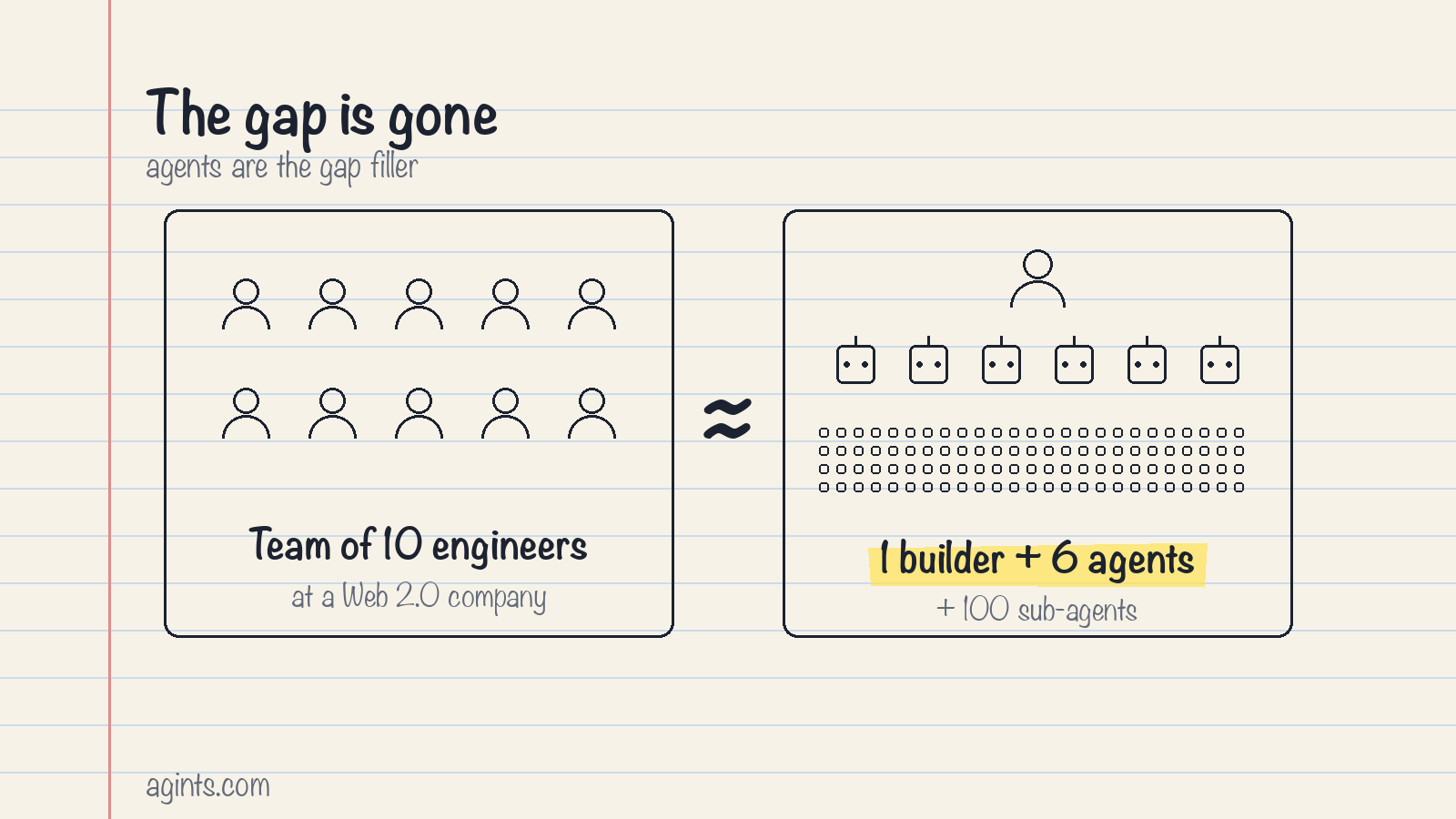
Agents are the gap filler.
Picture a team of ten engineers at a company like Dropbox. Now picture one person with two years of AI development experience, running six capable agents and a hundred sub-agents.
That one person can match the team. Or beat it.
These companies still see AI through the lens of 2024 and 2025, when Cursor, Windsurf and the other AI editors were rough and basic. They’re stuck in that paradigm.
They haven’t accounted for what an agent does in the hands of someone decently capable. That person can build their way to something competent, and competitive with whatever moat the big company thought it had.
The mispriced risk
So I think a massive dislodging is coming for the big companies that mispriced this risk.
It started with Grok Bot. Then came GPT-6 Astra and its Dots agents. Now Claude Opus 5.5 gives you more for every dollar of tokens.
Right now these companies are trying to figure out how to use an AI agent because it’s a hot buzzword. What they’re missing is the developer class.
That top tier of maybe 5 million engineers is heading toward four or five times that size. The models got better. The harnesses got better. And agents now fill the gap that used to be the moat.
This is going to make big, big noise in corporate America in 2027. And I’m all for it.
This is what I see, and my job is to bring it to the surface. I hope this helped you see that the new paradigm hasn’t worked its way through Web 2.0 yet.
I’m excited for the future.
Want to learn how to launch AI agents and develop software?
Come visit us at school: skool.agints.com. We teach AI agent engineering, start to finish.
 Mike Rodriguez
CTO
Author: The Agents Are Coming · Agents for Business 101
Mike Rodriguez
CTO
Author: The Agents Are Coming · Agents for Business 101
Get the next one in your inbox → agints.substack.com
P.S. A lot of billionaires are doing this.