

Notes from the Galaxy
The GTM Engineer Has Six Months Left. The GTM Agentic Engineer Is Next.

Clay made GTM engineer a real job. Agents are about to change what that job is.
This post is about the go-to-market engineer, a role I think only has about six more months as we know it.
What the difference looks like in real life
Let me give you one small example of the gap between a GTM engineer in April 2026 and one in November 2026.
DeepSeek’s newest V4.1 Flash update had just landed. People were calling it a monster that barely costs anything to run, so I decided to try it on a real lead list task.
I pulled 3,854 leads from Instantly as a test run, the first step before the full list. I told my agent Hermes, these are my leads, and I want DeepSeek to enrich them. We turned on the API key and ran it. I also wanted to know how good the results really were, so I set up a judge panel of three agents to score them. That way I’d get an unbiased, objective read instead of my own gut feeling.
DeepSeek crushed it, both on performance and on cost. This job would normally have gone to Kimi K3.1 Pro, which is what I’d been using (and it was brand new too). Before that it would have gone to OpenAI models. DeepSeek V4.1 Flash gave me the same or better performance than Kimi K3.1 Pro.
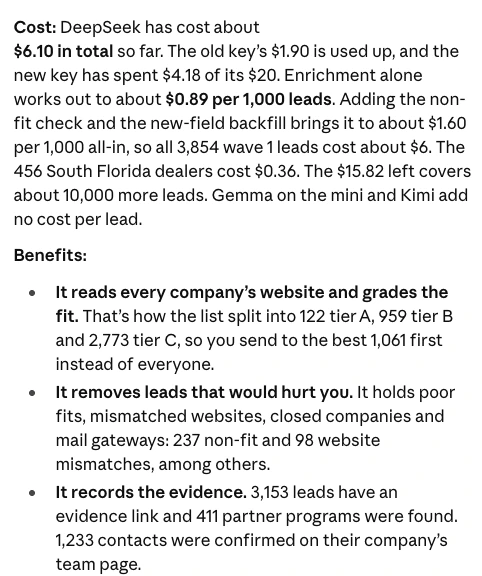
This is what it actually did. It read every company’s website and graded the fit: 122 tier A, 959 tier B and 2,773 tier C, so the best ones get sent first. It pulled out the leads that would hurt us (237 non-fits, plus mismatched websites, closed companies and mail gateways). It also recorded evidence, with 1,233 contacts confirmed on their company’s own team page.
Then there’s the cost. Enrichment alone came to about $0.89 per 1,000 leads. All-in, with the non-fit check and backfilling new fields, it was about $1.60 per 1,000, or about $6 for all 3,854 leads. So far the whole test has cost me about $6.10 in DeepSeek API spend. At list prices, Kimi K3.1 Pro costs about 7 to 8 times as much per token as DeepSeek V4.1 Flash, and more like 13 to 17 times as much if you run DeepSeek off-peak. For me, lead enrichment is now about 10 times cheaper, and that stays with me.
Next, the agents checked personalization on the top 353 leads (P1 and tier A). They graded every line. Any line that was generic or wrong, they rewrote from real evidence, with nothing invented.
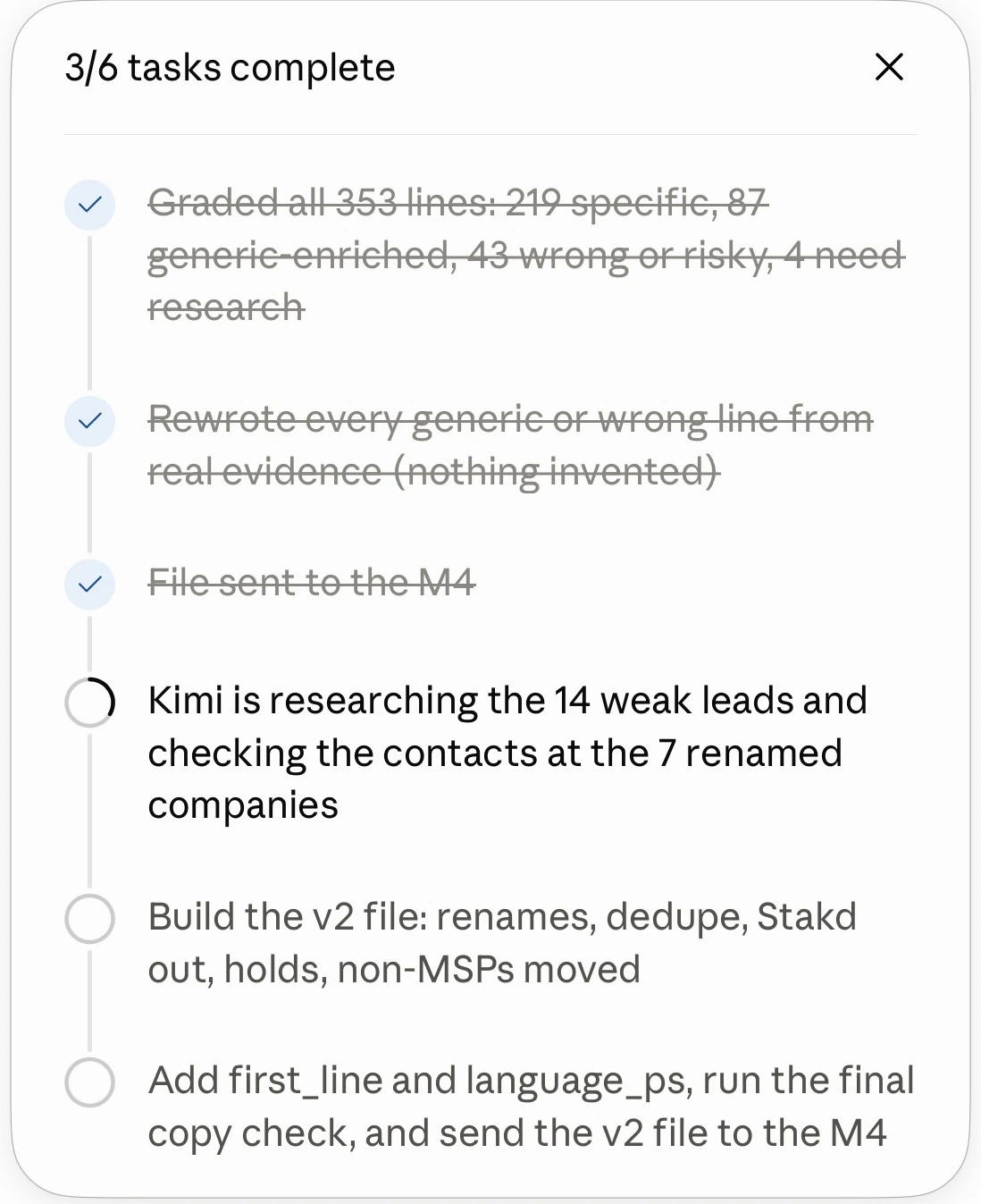
These quick adjustments make a big difference. The ticket to being a great agentic GTM engineer is putting new models to work as soon as they come out, because the closer you are to the frontier, the faster and better your work gets. You have to know your way around the space and know when an experiment is high reward and low risk. Then you have to spin it up fast enough to answer a simple question: is this new model the same or better value than what I’m using now? And you have to judge it correctly, with objective agents, so you can trust the answer.
That skill is what separates GTM engineers from GTM agentic engineers. To see why it matters, start with where the title came from.
Where the title came from
Clay coined the title “GTM engineer” a couple of years ago, and over the last year and a half or so it became the job title everyone wanted, especially on X. It was a genius marketing move. It pulled together a lot of fragmented skills that lived with marketers who specialized in startups. Those were the people who came in right as a product was about to be finished and the team needed to figure out its path to market.
Clay put the title on the map and pushed hard to make it a thing. It became the default answer to “we need someone to get us traction, and that’s what you own.” They also used it to train people on Clay itself: getting leads, figuring out cold outbound, figuring out LinkedIn and X, and figuring out outreach on a few other platforms that directly make money.
That’s a level above someone who says, “I’m going to put out content, do some paid SEO, and work on organic SEO.” Organic SEO takes six to 12 months. GTM is about compressing all of that into the most profitable, highest-yield actions so you can build a plan that gets you the hockey stick as soon as possible.
It’s a great position, and humans had to get good at it first. Only then could we ask the next question: how do we package this up into something an agent can do?
Breaking GTM into lanes

First you have to organize what a GTM engineer actually does. Once you break it out, you look at each process, each lane, and ask how to hand it to an agent so it runs efficiently and also performs at a high level. You want both.
So you break out cold email. You break out LinkedIn. You need a YouTube lane and an Instagram lane. You probably want a TikTok lane. You might even want agents on Snapchat, which is highly underrated. And you want an agent taking care of X.
Then you figure out where your ICP lives and build pathways that get them to notice you and book a demo.
That’s what we’re doing. We’re mapping all of this and applying agentic processes to each lane.
Cold email first, and LinkedIn is hard
The fastest lane to start with is cold email, but it has a lot of hurdles. You’re doing a dance to keep Google and Microsoft happy, keep Spamhaus happy, and keep your bounce rate down.
LinkedIn is tough. If you put your bots or agents on LinkedIn, you will get banned. It’s not a question of if, it’s a question of when. Their defenses are very strong, and their User Agreement bans bots and automation outright. I’ve tested it myself and gotten banned many times in the last 60 days. It sucks.
On YouTube, thumbnails drive a lot of what happens.
The mix depends on your ICP
In GTM you have to figure out the right allocation of resources and time for each channel. If you’re going after enterprise, it’s probably a different mix than if you’re targeting e-com stores. If your target is brand new startups, that’s another mix, because a lot of them live on X. If they’re tech forward, they definitely live on X.
So the allocation of resources and the makeup of your GTM plan has to be studied. That’s where the human steers. They bring the taste, the analysis and the judgment, and they steer an army of agents running in each lane.
Build it in parallel, hit play at launch

GTM used to take three to six months to stand up. With agents, if you know how to steer them, you can get your GTM ready in parallel while the product is getting ready to launch. As soon as the product launches, you hit play.
So what are the advantages of agent-led GTM? First, lower cost. Startups don’t have a lot of money, and they usually have to show results before they can go raise more. Now you can get a GTM engineer who steers many high-producing, efficient agents. That person is worth more than a team of three or four people manually running each channel the right way, and they’re going to get paid more.
Are you going to get the same results as a big, proper GTM team with a human running each lane? We don’t know yet. What I’m seeing, and this is my guess, is that you can probably get it done for 20 to 30% of what it cost even back in the spring of 2026.
April 2026 versus November 2026
I’m writing this to put anyone who calls themselves a GTM engineer on notice, because that by itself isn’t good enough anymore. What’s starting to be good enough is being a GTM engineer who steers a team of agents in each of these lanes and gets them to produce what the business needs to hit its results. That’s the 10x hire teams are going to want.
Look at the difference between a GTM engineer in April 2026 and one in November 2026. In April, you’d say, “Yeah, I use Claude Code and I do a lot of my work with Claude.” That was the answer back then. If you haven’t moved your workflows onto agents in the last six or seven months, you’re way behind.
So this is the notice. Put your focus on steering the agents that run your GTM activities. That’s the only kind of GTM engineer that’s going to survive in 2027. Otherwise you’re going to lose to every other team.
You can’t out-leverage a person who understands GTM, has good taste, and above all knows how to steer 10, 20, 30 or 50 agents to get the job done. They’re doing it for a fifth of the price of a team of humans who are chatting with ChatGPT, getting a few images made, maybe doing a little video editing here and there, and piecemealing their way through AI at a basic level.
That team won’t hold up against someone who can steer an army of agents across every GTM lane and hit every deployment milestone. That person never runs out of bullets. All they have to do is pop another $200 plan in the clip, and off they go, doing the work of 10 people in three or four days.
The shift happening this fall
This is the shift we’re seeing right now in fall 2026. The GTM engineer has turned into the GTM agentic engineer. It’s my job to talk about how agents are taking over, and they’re taking over in big ways and in subtle ways. If you want to stay on top of the trend, you have to notice the subtle ones.
That’s what I’ve got for you, hopefully it helps.
If you want GTM taken care of in your business, we can handle it for you. Go to agints.com/free, talk to Gini, and see where you can put agents to work. More than anything, tell us what you’re trying to achieve with your GTM.
 Mike Rodriguez
CTO
Author: The Agents Are Coming · Agents for Business 101
Get the next one in your inbox → agints.substack.com