

Notes from the Galaxy
Agent Platforms Need Agent Payments

My back of the napkin plan for turning a free video tool for agents into a lasting business.
Two pieces of agent infrastructure
I want to talk about something I think is going to change how a lot of work gets done. You build a platform where agents can do real work, and then you bolt an agent payment system onto it. Those take different skills. Put them together and you get the start of a very big piece of infrastructure.
Agent infrastructure comes down to two things. The first is a platform where agents can do something productive. The second is a way for those agents to pay for it. Let me take them one at a time.
The platform: HyperFrames
My favorite example right now is HyperFrames. It’s an open-source framework made by HeyGen, and it’s built for video.
Here’s how it works for me. I tell my agent what I want. Here’s the video, here’s roughly how I want it to look, go get it done. The agent writes the code, and HyperFrames renders it into a deterministic video. Same input, same output, every time.
In my experience, what comes out is about 95% of what you’d get if a custom editor spent two or three days on it. The quality is really good. It’s not always exactly how I’d have done it, but it’s good enough to ship, and it impresses most people who see it.
That’s the platform side. An agent doing useful work that used to take a person days.
The problem with popular free tools

Here’s the catch. A lot of agent tools start with tinkerers. Someone builds a thing, puts it on GitHub, and people love it. It goes open source and picks up stars and popularity.
But maintaining and growing a project takes time. If you need to work to pay your bills, a popular free project doesn’t pay you. So the tool everybody is using ends up running on somebody’s nights and weekends, or it stalls.
To be fair, HyperFrames isn’t in that spot. It has a company behind it. HeyGen has said it’s open source and free forever, and they already sell hosted cloud rendering. It also has more than 71,000 stars on GitHub, so people clearly want it. But plenty of open-source agent tools don’t have a company behind them.
That’s where agent payments come in. Payments added later, once a tool already has users, can fund the maintenance and the growth. Micropayments on Solana make that practical. A payment settles in well under a second, and the network fee is a fraction of a cent. Agents already have open ways to pay on Solana, like x402 and the Machine Payments Protocol, so the pieces already exist.
My back of the napkin plan
So here’s what I’d do as a CTO if I were shaping HyperFrames as a business. This is a rough scaffold, not a finished plan.
Let’s say a platform has 20 million videos made on it. That’s a lot of usage, and you can start running some back of the napkin numbers on it.
First, pick a unit. I’d use a 30-second short.
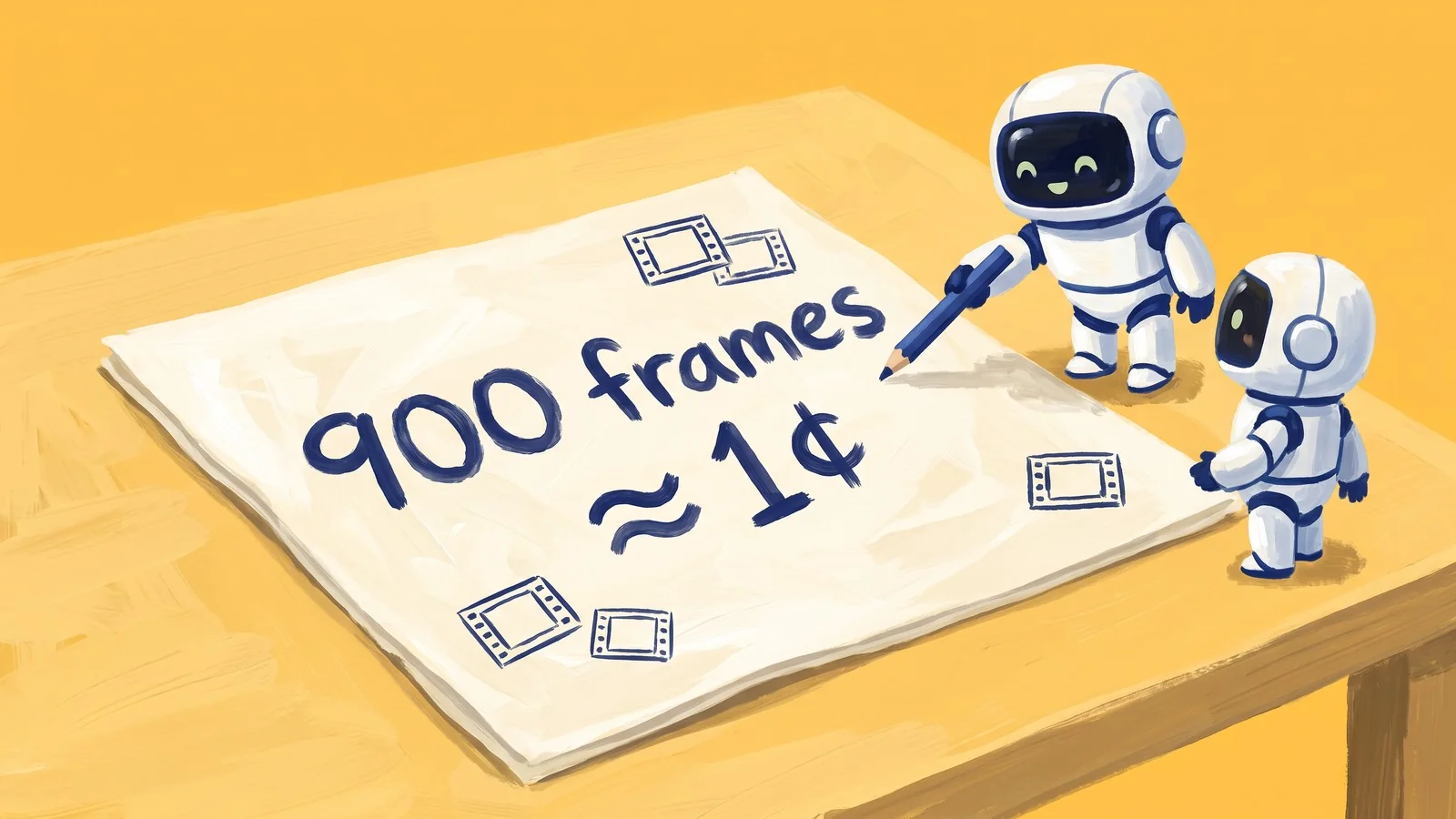
Next, decide how to price it. Per second is a little awkward. Per frame works better, because every video has frames and you can count them. A 30-second short at 30 frames per second is 900 frames.
For early adopters, I’d charge $0.00001 per frame, paid in USDC, a dollar-pegged coin on Solana. Here’s the math once: 900 frames at $0.00001 each comes to $0.009. So roughly a penny per short.
Anyone who signs up in the first 90 days gets that early-adopter price. They were first, so they get the best deal anyone will ever get. Then after three to six months, the price goes up 10x to $0.0001 per frame. That’s about 9 cents per short. Call it a dime. Still very cheap. You’d experiment with the timing and see what works.
The fee problem, solved. You count per frame, but you don’t send an on-chain payment for every frame. The network fee would cost more than a single frame. That’s where the Machine Payments Protocol on Solana comes in. It has a session mode built for lots of small, related payments. The agent opens a payment channel on-chain with a maximum deposit, basically a cap. As frames render, it sends signed vouchers with a running total. The server checks those off-chain, so there’s no transaction per voucher.
When the session closes, the server settles the highest accepted amount in one transaction. Whatever’s left of the deposit goes back to the wallet. Solana compares it to a bar tab or a prepaid meter. Here’s the thing. It doesn’t make fees disappear. You still pay to open and settle, just not on every frame. And the provider can cover those fees so the user doesn’t have to.
The growth engine is the early adopters themselves. They get in cheap, they make a ton of videos, and they spread the word to the next wave. By the time the price goes up, the next group is already showing up because of them.
Paying is the easy part
If you’ve never used Solana, don’t worry, it’s not hard. Download Coinbase or Kraken, buy a few dollars of USDC, send it to the wallet address on Solana, and bada bing, bada boom. Your agent can start making videos.
$10 covers about 1,100 shorts at the early price. If you make two a day, that lasts more than a year. At the later price, $10 gets you about 110 shorts. Make three or four shorts a week at that price and you’re spending a little over a dollar a month.
Now compare that to traditional editors. Adobe Premiere is about $23 a month on a subscription. Final Cut Pro is about $300 one time, or you can go with a monthly plan. DaVinci Resolve has a free version and a paid Studio version. But honestly, the license isn’t the big cost with any of them. The big cost is the hours a human editor spends in there.
Nobody’s being asked for $20 a month here or some serious commitment. You load a wallet with a few bucks and keep experimenting.
Everybody wins

The user saves money and a lot of time. The maintainers get paid to maintain and grow the thing, and they can hire enough people to keep making it better. And the cost is so small that creators can punch out a huge amount of content. When you make that much, you end up talking about the tool that made it possible. So creators wind up promoting the platform on their own.
It also sets a precedent. Other open-source projects can look at this and see a path. Build something people love, get a strong user base, then bolt on payments once there’s traction. No subscription required, and the project stays alive.
Crypto gets a real-world use too, with an agent paying a few cents to get a job done. I believe this could become the standard way agents pay for video.
If I was Adobe, I’d be shaking in my boots. I never really liked Adobe. They totally screwed me back in the day with a subscription fakeout, the kind where the monthly plan turns out to be an annual fee. And well, this seems like a great way to repay the favor. Helping remove that behavior from tech would be quite the win in my book.
I’m a big HyperFrames fan. It has completely changed our content. I’d happily give some of my time to help build a lasting business around it.
Drowning in busy work like inbox and research? We install a digital secretary that clears 30–70% of your busy work, even while your laptop is closed. agints.com/free
 Mike Rodriguez
CTO
Author: The Agents Are Coming · Agents for Business 101
Get the next one in your inbox → agints.substack.com