
Notes from the Galaxy
Sam’s “Worth the Wait” Ship Looks Like a Grok Bot–Style Harness
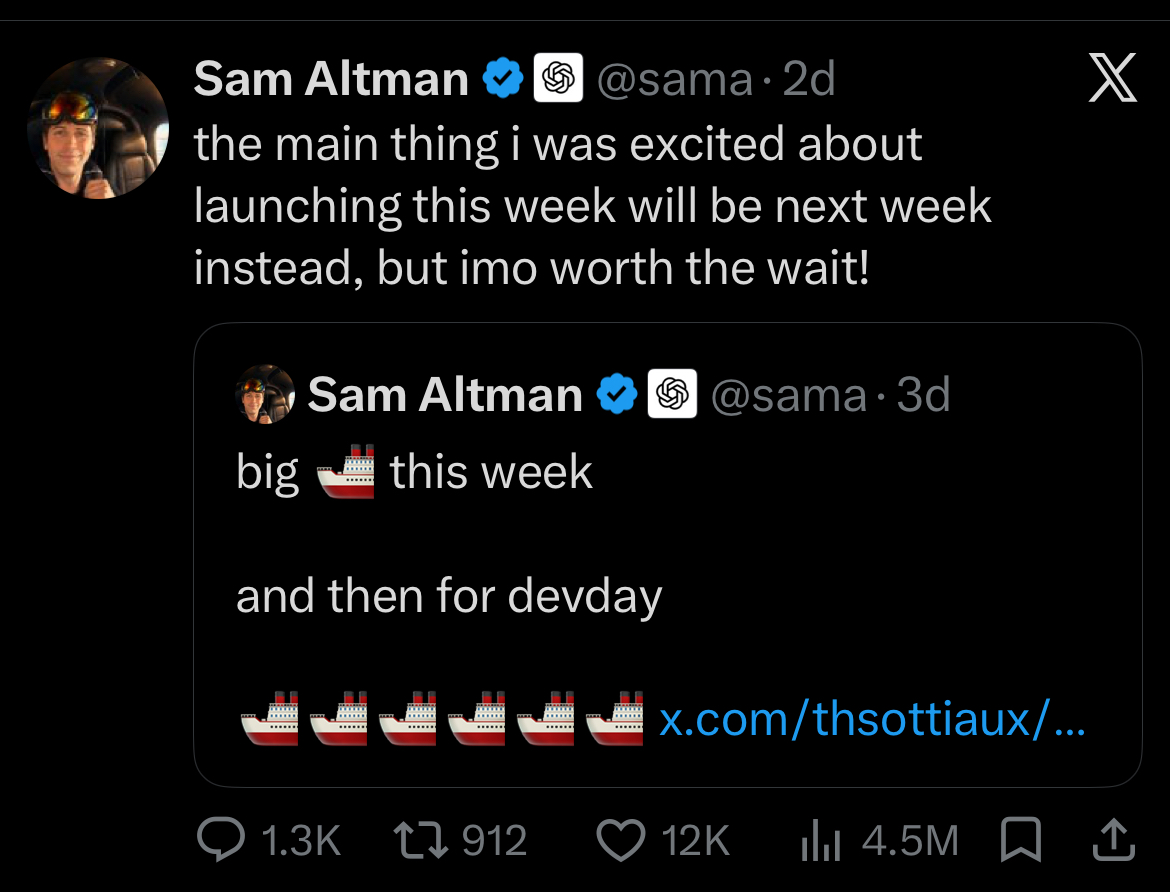
Sam Altman is excited about launching something — just not on the original week.
On X, he said the main launch he was excited about for this week moves to next week, but it’s worth the wait. He didn’t name the product.
[Dart] The read from here: it’s probably OpenAI’s own agent harness — something in the same family as Grok Bot. Not another chat product. Orchestration.
That’s the gap OpenAI still has to close.
Codex is parallel. Grok Bot is one head of staff.
Right now OpenAI doesn’t have the orchestration Grok Bot has.
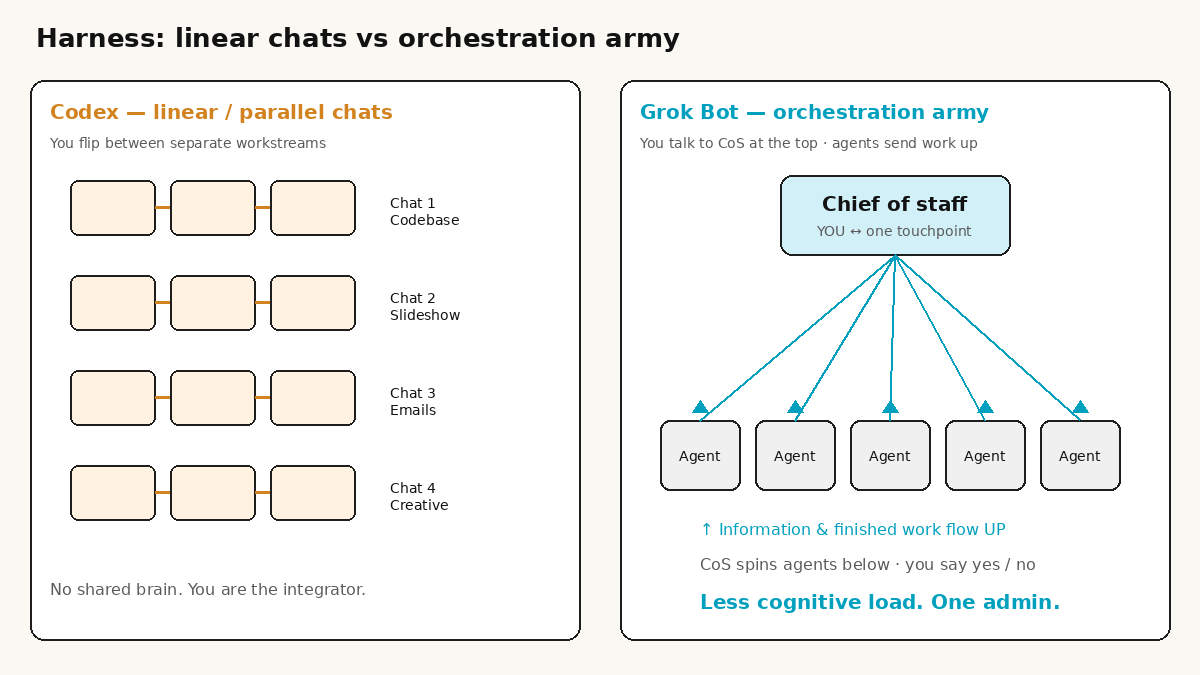
Codex runs a lot of linear tasks. Want it on your codebase, a slideshow, draft emails, and creative strategy? Those workflows can all run at the same time — but they live in parallel universes. They don’t integrate. They don’t collaborate.
So you end up with five, six, seven, eight, thirteen chats open. You flip between them. You carry the context in your head.
Grok Bot’s model is different. You have one head of staff — a chief of staff. Conversations route back to that touchpoint. Other agents spin up, do the work, and pass completed work up. You say yes or no.
Less cognitive load. Cleaner. A lot more user-friendly if you don’t want to manage thirteen chats — you just want one admin.
Why the merge matters: GPT-6 Astra + Grok Bot–style harness
OpenAI needs this badly.
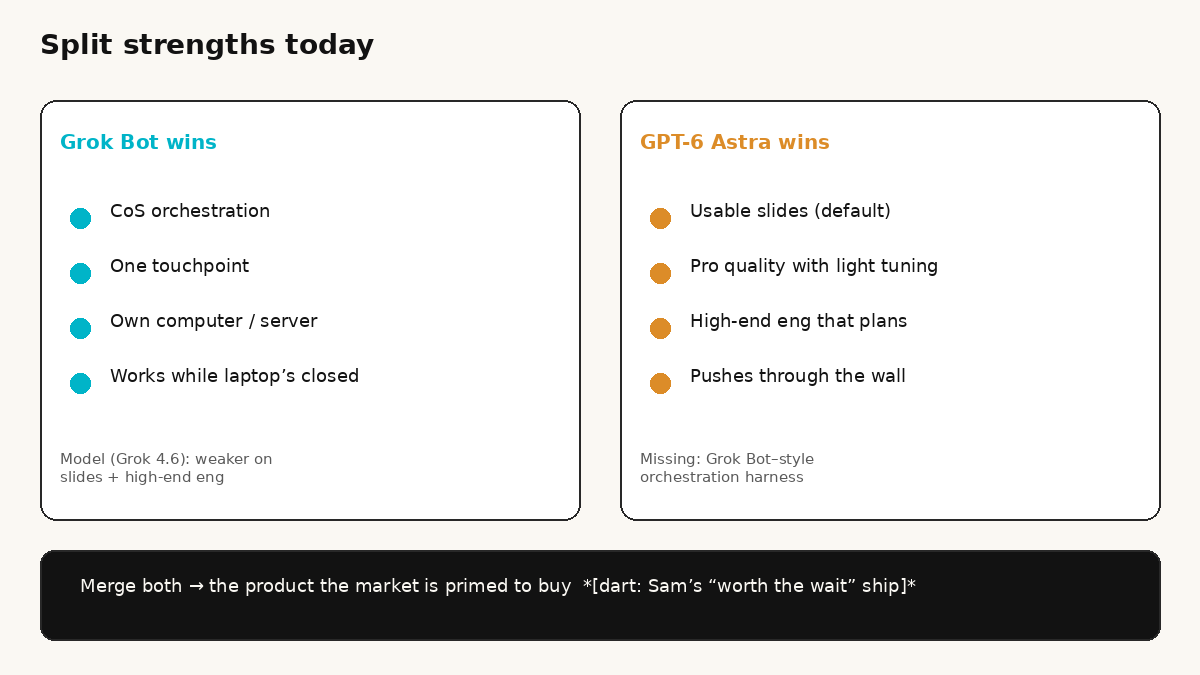
[Dart] If they can put GPT-6 Astra’s functionality into an orchestration harness like Grok Bot’s, they get a significant advantage.
Why? Grok Bot already has the orchestration. Their model line around Grok 4.6 is clearly inferior to Astra. It’s a very big difference.
I’ve been someone who, for the last three or four years, didn’t really notice model differences. Opus 5.0 versus ChatGPT 5.3 or 4 / 5.6 — after twelve hours you might catch a few strengths and weaknesses. Nothing glaring.
With Astra and current Grok 4.6, there’s a massive world of difference.
Two examples.
Slideshows. On Grok 4.6, they’re barely usable — most of them unusable. Graphics garbled. Text overlaid on the graphic. Graphic covering the text. Garbage as a default. You tune and tune and tune to get something mildly usable, and the default design taste is terrible. On Astra, you usually get usable out of the gate. With a little tuning, something professional and high-end.
High-end engineering. Astra completely outperforms. Grok Bot stays stuck — not a lot of creativity finding workarounds, bypasses, or solutions that push through the wall. Astra will plan for a long time, then run through the motions, chip away at the stalemate, and get you through.
Those two advantages, inside a Grok Bot–style orchestration harness, and the market would completely eat it up.
Astra’s been down about one or two weeks since release — mostly people living on Codex and wanting access because it’s so profoundly good.
Grok Bot’s other win: the computer that keeps working
Grok Bot is growing for two reasons.
One: tedious work done with one contact point.
Two: it can work while you’re sleeping and your computer’s closed. It has its own server — its own computer — that runs a lot of the tasks. That’s a big one.
ChatGPT and Codex work locally, mostly. Close the laptop and yes, maybe something runs in sleep mode — but it’s not the same. Grok Bot generally has its own internal computer, so a lot of it can run in the background.
The flip side: Grok Bot sometimes just doesn’t have the strength or higher intelligence to grind through high-end design or high-end engineering. That’s where Astra shows up.
Moats right now
Three different edges are showing up at once.
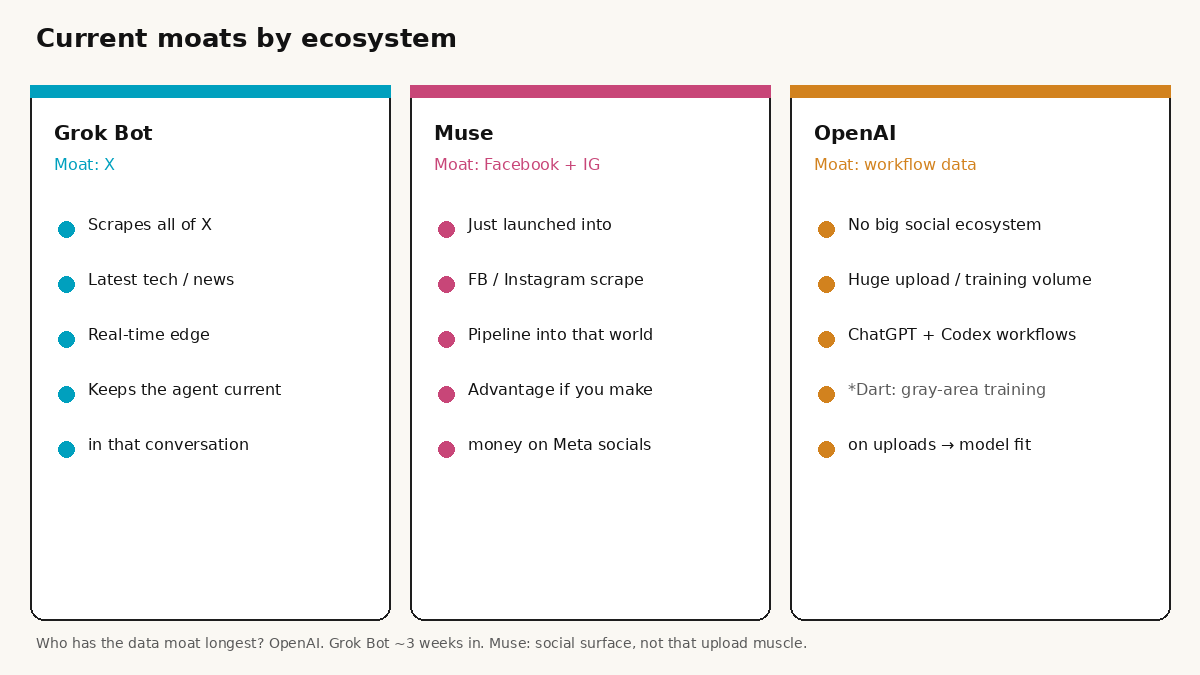
Grok Bot’s edge is X. It can scrape X — the latest news and the tech-forward conversation. That keeps it in real time in a world that still moves first on that platform.
Muse’s edge is Facebook and Instagram. They just launched into scraping that ecosystem. If you make money in that world, a pipeline into what’s happening there is a real advantage.
OpenAI’s edge isn’t social. They don’t really have an ecosystem on the socials. What they have is training data and workflow volume.
[Dart] Even with the “your information is safe / we’re not training on it” language, there’s probably gray area. From recent developments, it looks like uploads into ChatGPT — and Codex — are refining the models, directly or with sensitive bits blanked out. People’s IP goes in. The models get better at those workflows.
Muse hasn’t gotten that. Grok Bot has only really started tapping it in the three weeks since launch. OpenAI has been harvesting and adapting longer.
That’s why the harness matters. If the “worth the wait” ship is orchestration plus that workflow-trained model muscle, it gets user-friendly fast. Codex is good. The UI isn’t great. A real upgrade from Codex is what people will feel first.
Not a hype piece — a Q4 read
I’m not a fan of OpenAI overall. This isn’t a hype article about them.
It’s the lay of the land for quarter four — October, November, December — when people generally want more time off and start offloading tedious work onto models. That’s a growth window for all the agents that have hit the market.
Muse came out about four or five days ago. Grok Bot’s been out about three weeks. Jev showed up in the last three or four days and is doing interesting classification work. [Dart] And now it looks like Sam is responding with his own harness — almost certainly shaped by the Grok Bot release three or four weeks ago.
As someone who’s been dealing with agents for two to three years: everybody’s waking up to the collaborative power of agents running on (or for) your computer. More of that conversation is leaving X and the tech-native crowd. It’s showing up on LinkedIn, Facebook, Instagram.
Muse makes it more mainstream with a targeted “make me a reservation” style app. That starts to look like traction — not only with people who aren’t tech-forward, but with anyone who wants pragmatic offloading of tedious tasks they don’t want to deal with.
[Dart] Sam’s trying to carve into that market. We’ll probably see the release next week. We’re looking forward to diving in — what makes it work, where the optimizations are, how you get the most juice out of the squeeze on token usage if this agent ship lands.
You can find more of how we think about installations that adapt to real workflows at agints.com. Hopefully Sam has a winner. We’re looking forward to it.
If you want a Chief-of-Staff agent installed for your business in about 90 minutes, that’s what we do at agints.com. If you just want to talk it through first, start a free conversation with Gini.
Mike Rodriguez, CTO