

Notes from the Galaxy
OpenAI’s DevDay Shipped a Coworker, Not a Chatbot

OpenAI’s DevDay dropped a few hours ago, and I went through every release slide by slide. There were twenty-five of them. You don’t need to memorize twenty-five things. You need to understand one: the product is no longer a chatbot. It’s a coworker.
Everything else they shipped is either that coworker, the office they’re building around it, or the pricing that pays for it.
A quick honesty note before we start: most of this is hours old. I’m reading the release notes and telling you how I think it plays out. I haven’t used most of it yet, and I’ll report back once I have.
They called it Dots
The headline is OpenAI’s new agent, and they called it Dots. Not sure about the name. The product is the point.
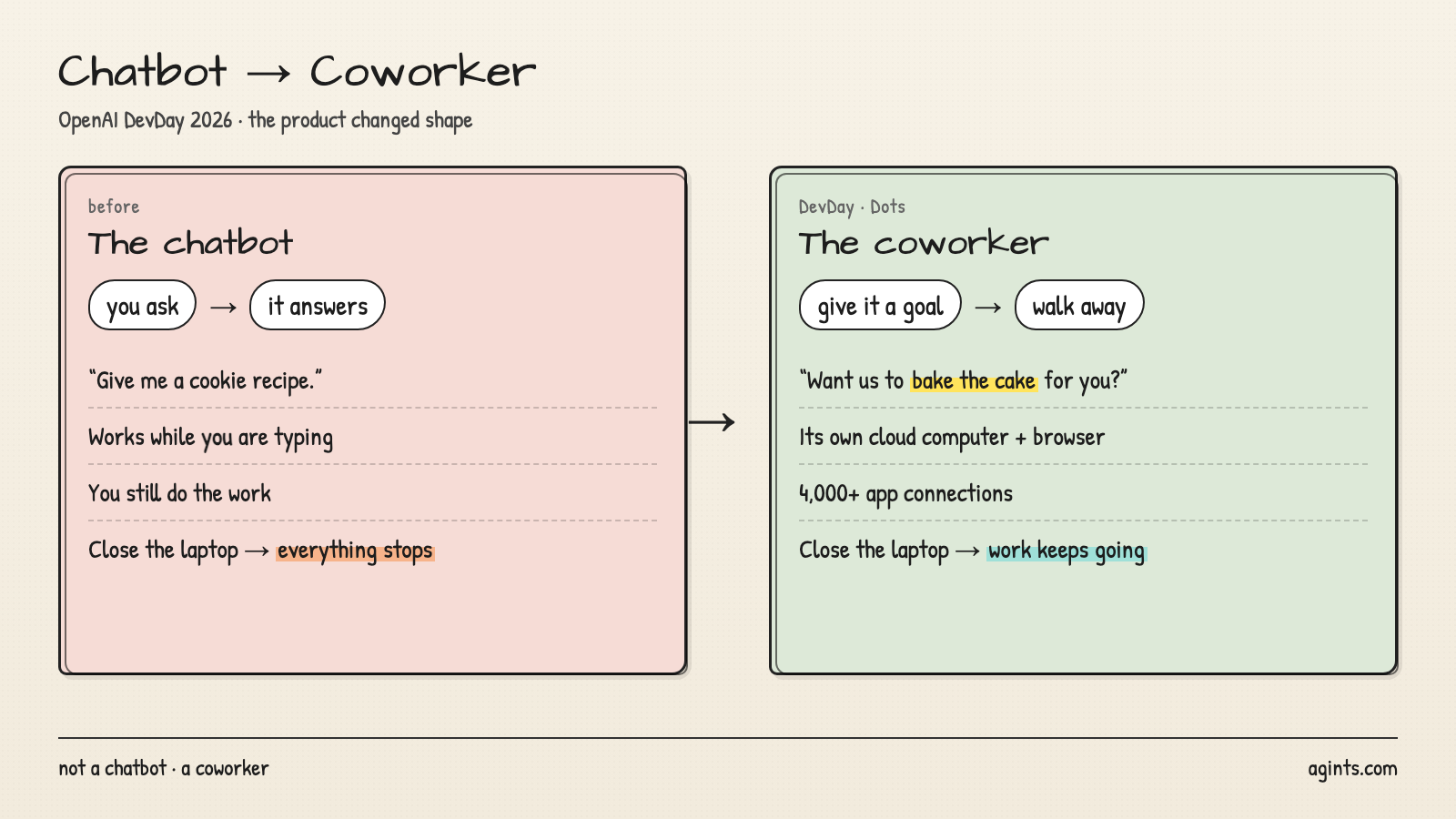
Dots is an always-on agent. It has its own computer in the cloud and its own browser, it’s powered by GPT-6 Astra, and it comes with more than 4,000 app connections. The first Dots is included on Pro and Business Premium accounts, so if you’re already paying for ChatGPT, you don’t have to plug anything new in. Keep doing what you’re doing.
The line that matters: it’s not just a chat box. It’s a coworker that keeps working after you close the laptop. That’s what agents are for. OpenAI is positioning it as an office suite shared by humans and agents, aimed at a platform of about 1.2 billion users, and it’s going head to head with GrokBot.
If you’re not on agents yet, this is the plug-and-play on-ramp.
The model and the money
Dots comes with a new model, GPT-6.1 Sol, which they put near Astra on coding, computer use and professional work. It’s live now in the API, Codex and Work, not just regular ChatGPT. Big plus.
The same announcement quietly moves the pricing. The $200-a-month plan is getting trimmed. The pitch from the Codex team is that the models are more token-efficient, so you’ll get fewer tokens but more work done. That math also sets up the new $500 plan. More on that below.
Then there’s Ultrafast: up to 8× faster in Codex, so a task that took 20 minutes takes about three. In the API it’s up to six times faster, and also six times the price. Honestly, I have no idea who needs that unless it’s something critical that has to ship right now. It’s there if you’re in a hurry.
Private Intelligence, with a raised eyebrow
Private Intelligence is the privacy release: zero data retention, private processing, and safety reviews without staff seeing your content.
It’s good that they’re publishing it. Do I really believe it? It’s doubtful. They have access to pretty much everything: what you upload, a lot of the ways you do business. This is a step in the right direction, but it will take more than a DevDay slide to convince me nobody looks at what goes up to their servers.
Codex moves to the cloud
Five of the releases are Codex, and they all point the same way: work that happens while you’re away.
- Codex in the cloud runs from your computer, your phone or any browser. You can vibe code on the train or the plane. Teams get reusable environments with approved settings, and tasks keep going after your laptop closes. That’s what we’ve been saying on this channel for weeks: holidays, weekends, PTO, and the work still moves.
- The refreshed Codex CLI lets you start and steer tasks with your voice. Spin up a new instance and work there without touching production. Spin up agents for editing, blog quality control, an editing pass. Plus a cleaner UI, resume and worktrees.
- Code review brings summaries and diffs to the desktop app, reviews GitHub pull requests and GitLab merge requests, and does automatic first-pass reviews while you’re away.
- Codex Security Cloud scans your repos on demand or on a schedule, investigates findings and drafts fixes in the cloud.
None of these is a revolution alone. Together they slowly improve the agent experience, and they all add up to one thing: more work done with the laptop closed.
The API layer: a week to clone a product
The Decisions API handles fixed questions with finite answers. It routes and chooses, accepts text or images, is Luna-based, and they claim it’s 10× faster than regular Luna calls. Under the hood it’s scoring and classification.
It’s also a direct shot at Jev, which launched about ten or twelve days ago as one of the most interesting decision-making breakthroughs we’ve seen in a while. OpenAI basically cloned it and shipped a rival in about a week. I haven’t tried it yet, but it’s live, so they’ve obviously tested it. That’s breathtaking, and it’s the lesson for every software company right now: labs with frontier-level knowledge can replicate a lot of software, fast.
The Agents API with computer use is the bigger one. Agents operate software through the UI, so they can use all your tools the way a person would. It includes multi-agent tools, search and context compaction, and OpenAI runs the infrastructure for you. You no longer need an interface. You call the API and multi-step workflows get done.
For AWS shops, Bedrock Managed Agents runs natively in AWS, hooks into resources inside your account, and was built with Amazon for enterprise deployment.
MCP events: the sleeper hit
Plugin extensions put native apps in the sidebar and the conversation, with interactive panels and custom file viewers. It’s the same surface OpenAI uses internally.
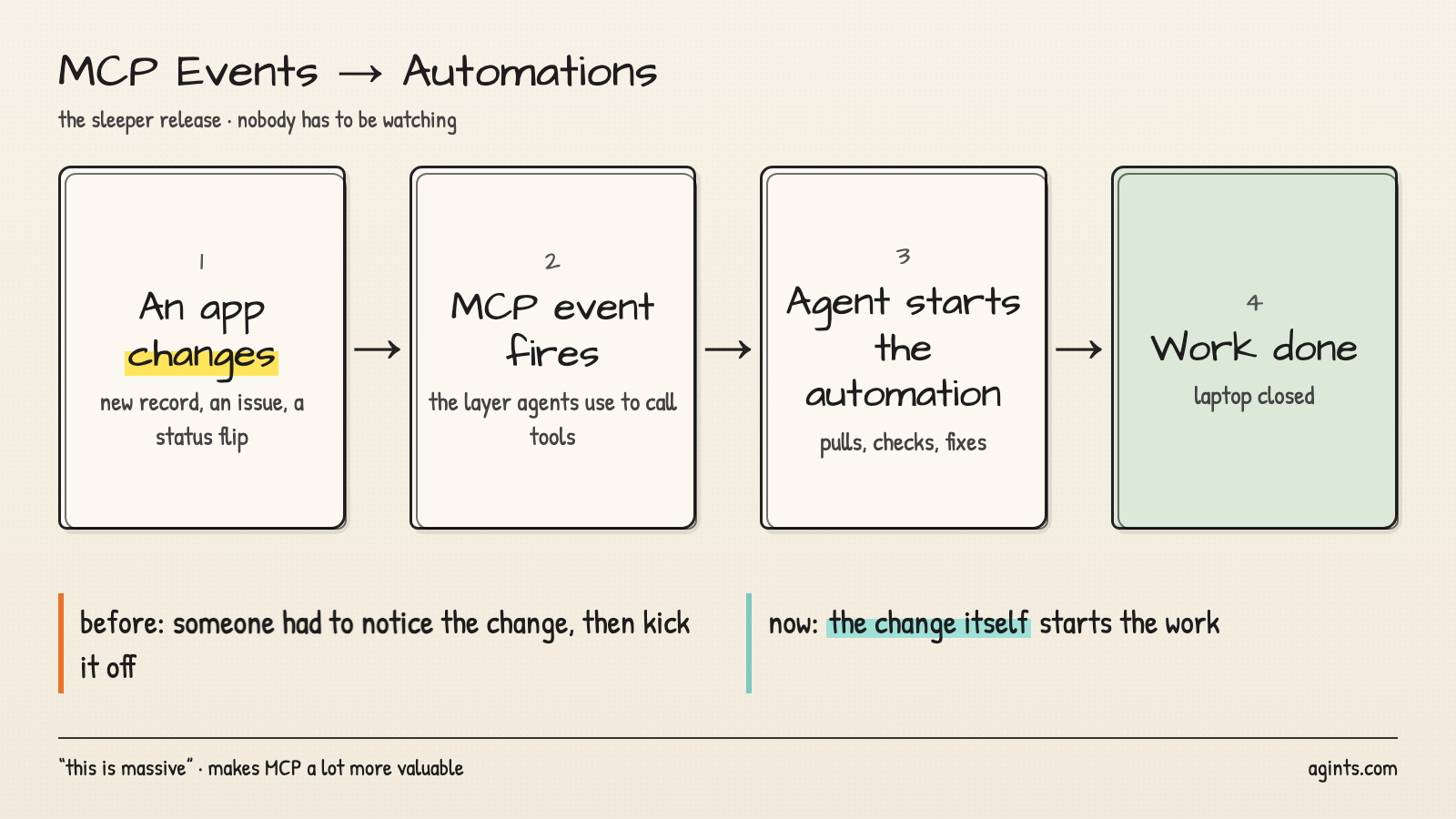
Then Plugins, Sites and MCP: better submission, ranking and discovery for creators; Sites that host plugins with per-user permissions; and the one I keep coming back to: MCP events start automations when apps change.
This is massive. I’ve been looking for exactly this in an engineering problem we’re working on. If you’re sending data through an MCP and something changes, say an issue shows up in what you’re pulling, the change itself can kick off the automation. No one has to be watching.
If MCP is new to you: it’s a layer that sits on top of an API and lets agents call tools and use that API. It’s agent-friendly, agent-native. Event triggers make it a lot more valuable.
The workspace land grab
This is where you see the real strategy.
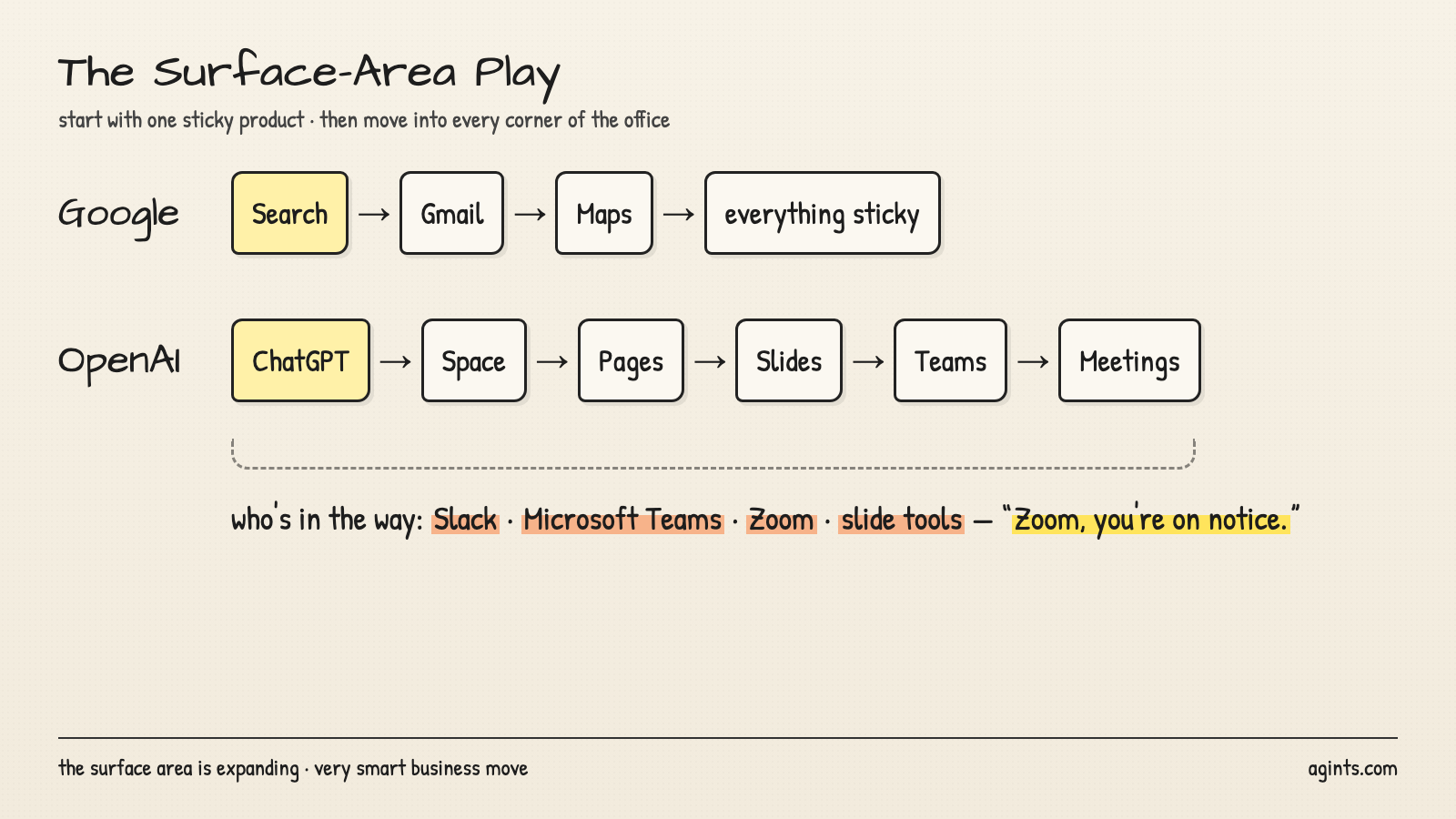
- ChatGPT Space is a shared home for teammates and their agents, with agent-organized knowledge you can pick up any time. Desktop and web now, mobile soon. It looks like a hybrid of Slack and having your agents in the room doing the work.
- Pages are documents built for humans and agents together. Humans search in fuzzy language (“find me the best part for this solution”). Agents query exactly: wider, narrower, optimized every time. Pages is built for both. You can write, research, chart and generate images, then invite the team in.
- Collaborative slides build decks from a conversation or a template. Humans and agents co-edit and comment live, and you can present in ChatGPT or export to PowerPoint or Slides. If you’re in marketing, learn agents: “Make me a 12-slide deck for an investor” is where this is going, and you get to focus on strategy.
- Teams, tasks and @ChatGPT let you share pages, slides, plugins and recurring tasks, and mention @ChatGPT inside Slack or Microsoft Teams. Teammates can refine results without their own license. Very permissive: toes in the pool.
- Meetings and profiles bring meeting notes and actions into Space (audio is deleted once the notes are ready, they say). Zoom, you’re on notice.
It’s almost like the play Google made: search first, then Gmail, then Maps, then everything sticky. The surface area is expanding. OpenAI is branching out from being an AI company into “bring your whole team over, we’ve got it all for you,” and taking market share from the established players as it goes. Very smart business move. Curious to see how it works out.
The pricing play
The last three releases are about money:
- Sign in with ChatGPT lets you spend your Plus and Pro quota in 16 partner apps, not just Codex.
- Pro 500 is the big launch: $500 a month for 25× Plus usage, Ultrafast included. The old top plan was 20× for $200.
- The Market lets you spend OpenAI commitments with partners like Adobe, Figma and Salesforce.
My read, at skin level: this looks like a revenue play. Trim the $200 plan (usage has felt a lot tighter in the last few days), tell everyone the new models do more with fewer tokens, and launch a $500 tier. I could be wrong. Maybe the $500 plan is the greatest thing ever. We’ll see.
The line: give it a goal, walk away
OpenAI’s closing message was simple: give it a goal and walk away.
There was some theater, too. They delayed GPT-6.1 Astra over security: “It’s so good, it’s scary, we have to delay it,” the same move we’ve seen from Anthropic. Meanwhile they still shipped agents with their own computers, and GrokBot copied them in under 30 days.
But the core message is right, and it’s what we’ve been saying for weeks. The product is not a chatbot. It’s a coworker. We’ve gone from “give me a cookie recipe” to “you want us to bake the cake for you?” Plugins, connectors, everything, and a clear pitch: pay us more and we’ll get it done.
Why push agents this hard? Because they can charge more for productivity. Instead of hiring an employee, spend the money with us. And for a lot of businesses that math works: an agent at $200–300 a month versus the cost and the headaches of PTO, vacation time and sick days. We wrote about this in The Agents Are Coming. They were coming. Now they’re here.
What it means for your business
OpenAI just put everybody on notice. As this moves from tech-heavy people to mainstream users, agents become the lever you can pull against inflation, hard hiring and heavy regulation, the stuff that has been pushing businesses down for five or six years. Now you have a shot at a counter-punch.
- If you’re ChatGPT-native, spin up Dots. It’ll probably work really well for you.
- If you’re not sure where to start, or you have something different in mind: start small. Crawl, walk, run. Small, easy wins first, then graduate.
That’s what we do at Agints. Go to agints.com/free and talk to Gini, our agent. Tell it what you want done, how your life could be easier, and where your challenges are. It’ll give you a full AI implementation plan for your business, with small wins first so you’re not overwhelmed. It’s free. Less busy work, more time back, even when your laptop is closed.
 Mike Rodriguez
CTO
Author: Agents for Business 101
Mike Rodriguez
CTO
Author: Agents for Business 101
Interested in standing up an agent for personal health and wealth, clearing admin busy work, or bringing revenue into the business?
Meet Gini at agints.com/free. We’ll put together a clear package on where AI fits in your life or work — and how to set it up with a few clicks. No credit card needed.
P.S. A lot of billionaires are doing this.