

Notes from the Galaxy
How to Steer an AI Agent at Your Job: One Real Grok Bot Chat
A few messages show how to give a direction, what a good agent reply looks like, and where you do the steering.
This post goes with my LinkedIn series on getting started steering AI agents at your job. At Agints we build custom AI agents for business, so I spend a good part of every day giving agents directions and reading what they send back. The clearest way I know to show how that works is to walk through a real chat.
The chat is short. It’s one message from me and two replies from Grok Bot. Still, most of what I’d tell you about steering an agent shows up in it.
The direction I gave
I wanted booking for our partner demo. I wanted it at revenue.agints.com/book, I wanted it added to the partner demo flow, and I wanted to use it to measure how much value Gini adds under revenue-share pricing.
If you don’t know Gini, it’s our phone and receptionist agent. You get a 14-day free trial, then it’s revenue share. So when Gini answers a call and that call becomes a booking, we can point to that value.
My message ended like this: “This allows us even more granularity to have an idea of how much value Gini provides for our monthly pricing on revenue share.”
That line was the why. I’ll come back to why it matters.
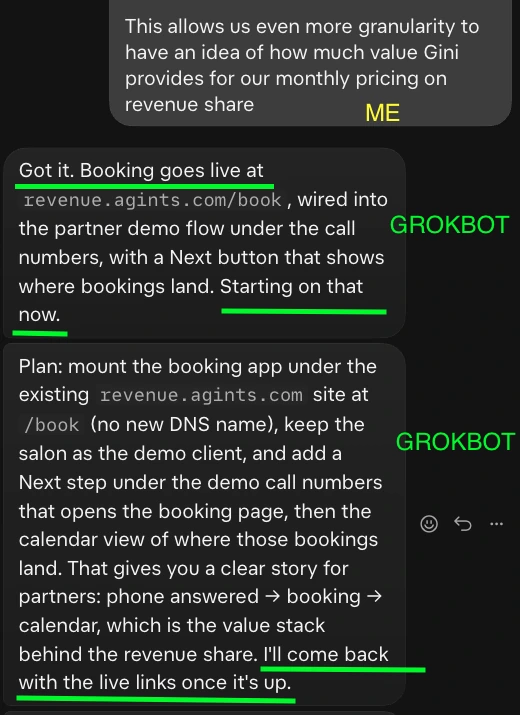
Here’s the screenshot. I marked it up myself with green underlines and ME / GROKBOT labels so you can see who said what.
What a good agent reply looks like
Grok Bot’s first reply was this:
“Got it. Booking goes live at revenue.agints.com/book, wired into the partner demo flow under the call numbers, with a Next button that shows where bookings land. Starting on that now.”
I underlined “Got it. Booking goes live at” and “Starting on that now.” The first part is the restate. In one line it tells me what it understood, and it gives me the exact place. If it had heard me wrong, this is where I’d catch it, before any work started. A one-line restate takes me a few seconds to read. Fixing work built on a misunderstanding takes a lot longer.
Then the second reply:
“Plan: mount the booking app under the existing revenue.agints.com site at /book (no new DNS name), keep the salon as the demo client, and add a Next step under the demo call numbers that opens the booking page, then the calendar view of where those bookings land. That gives you a clear story for partners: phone answered → booking → calendar, which is the value stack behind the revenue share. I’ll come back with the live links once it’s up.”
This is a plan I can actually work with. Look at “no new DNS name” and “keep the salon as the demo client.” Those are choices. They’re written out so I can say yes or no to each one. A plan that just says “I’ll build the booking page” gives me nothing to check.
It also tied the plan back to my why: phone answered, then booking, then calendar, which is the value behind the revenue share. That told me it understood the reason, not just the task.
The last line I underlined is the one I care about most: “I’ll come back with the live links once it’s up.” It didn’t promise to say “done.” It promised proof. Links are something I can click and check.
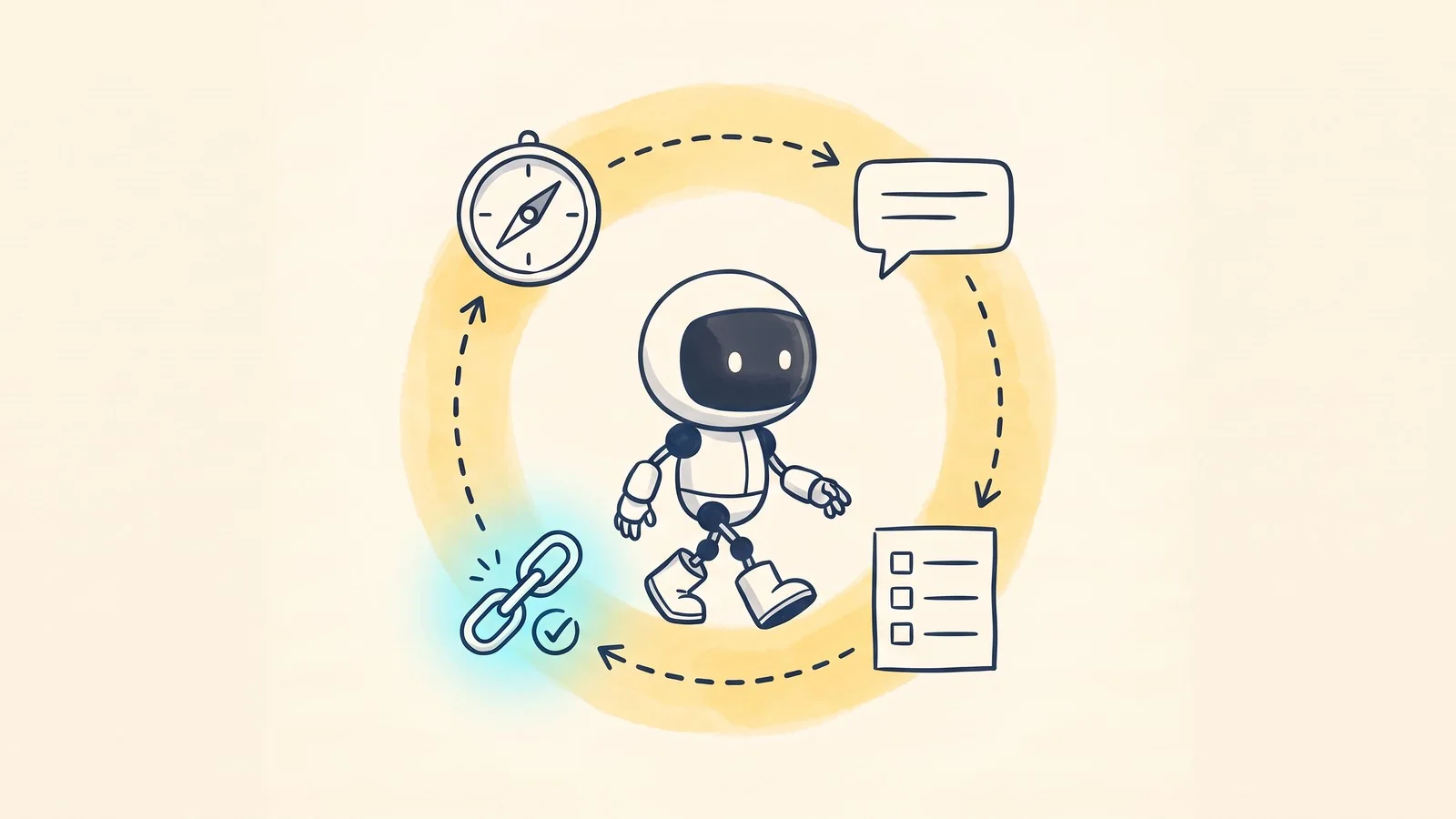
That’s the loop I want every time. I give the direction. The agent restates it. The agent lays out a plan. Then it commits to coming back with proof.
Give the outcome and the why, not only the task
A lot of people starting out with agents give a task and stop there. “Make a booking page.” The agent will do something, but it has to guess at everything you left out.
When you add the outcome and the why, the agent can make better choices on its own. My why was measuring Gini’s value for revenue-share pricing. You can see it in the plan: the Next step that shows where bookings land is the part that proves value to a partner.
Also name the where. I gave an exact URL. Don’t say “put it on the site.” Say which site and which path. If there’s a specific place, file, or page, name it.

Read the plan, because that’s where you steer
This is the habit I’d push hardest. Your steering happens when you read the plan, before the work starts. Once the work is done you can still correct it, but now you’re redoing work instead of adjusting a direction.
So when the plan comes back, slow down for a minute. Read each choice. Ask yourself if that’s what you’d do. If it says “keep the salon as the demo client” and you wanted a different client, now’s the time to say so.
If the plan is all good, a short “Yes, go” is fine. You don’t need to write a paragraph back.
How to correct an agent when it drifts
Sometimes the restate or the plan is off. When that happens, here’s what I do.
Reply to the specific line that’s wrong. Don’t rewrite your whole direction. Quote or point to the part that missed, and say what you want instead.
Keep it short. One or two sentences usually does it.
Restate the why. If the agent drifted, it probably lost track of the reason. Reminding it often fixes more than the one line you’re correcting.
Then ask it to restate again. That gives you another quick check before work starts. If the new restate is right, you’re back on track. If it isn’t, you caught it in a few seconds, not after the work was built.
Check the proof when it comes back
The chat ends where Grok Bot commits to coming back with the live links. That’s the right place for an agent to stop talking and start working.
When the links come back, click them. Make sure the page is at the URL you asked for. Walk through the flow the plan described and check that each step is there. The commitment to proof only helps if you actually look at it.
If something’s missing, you’re back in the correction step. Point to the gap, keep it short, restate the why.
Steering more than one agent
Once this loop feels normal, you can steer several agents at once, and that’s where custom AI agents for business really start to pay off. Each one gets a clear direction, sends back a restate and a plan, and comes back with proof. Your job turns into reading plans and checking proof instead of doing every step yourself.
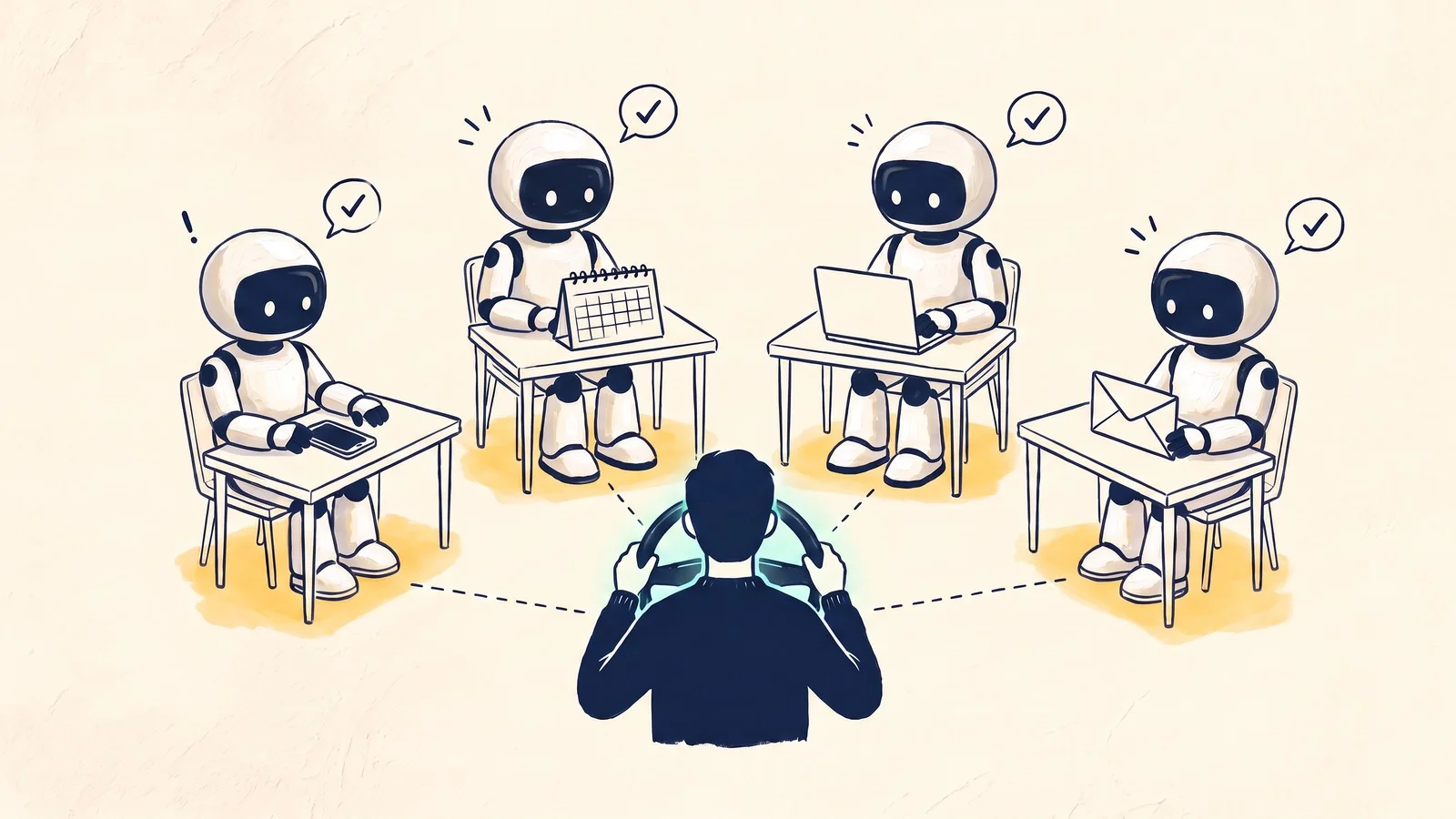
That’s how we think about agents at Agints. The agent does the work, and the person steering it stays in charge of the direction and the why.
If you want custom AI agents for business that work like this, go to agints.com/free, talk with Gini, and see where you can put agents to work.
 Mike Rodriguez
CTO
Author: The Agents Are Coming · Agents for Business 101
Get the next one in your inbox → agints.substack.com