

Notes from the Galaxy
Tech Moats Are Gone

Tech moats don’t really exist anymore.
The build-out process has gotten so short that anybody with decent software skills and a capable AI agent on a $200 plan can build most consumer-facing platforms, apps and software in a few weeks. Something a lot more complex might take a few months. Either way, you can get to 80 or 90 percent of most software out there, and the same goes for the leverage.
So what does that tell you? Tech is a commodity now. I wrote about the gap closing between big-tech teams and solo builders in Web 2.0 on Notice. This is the next step.
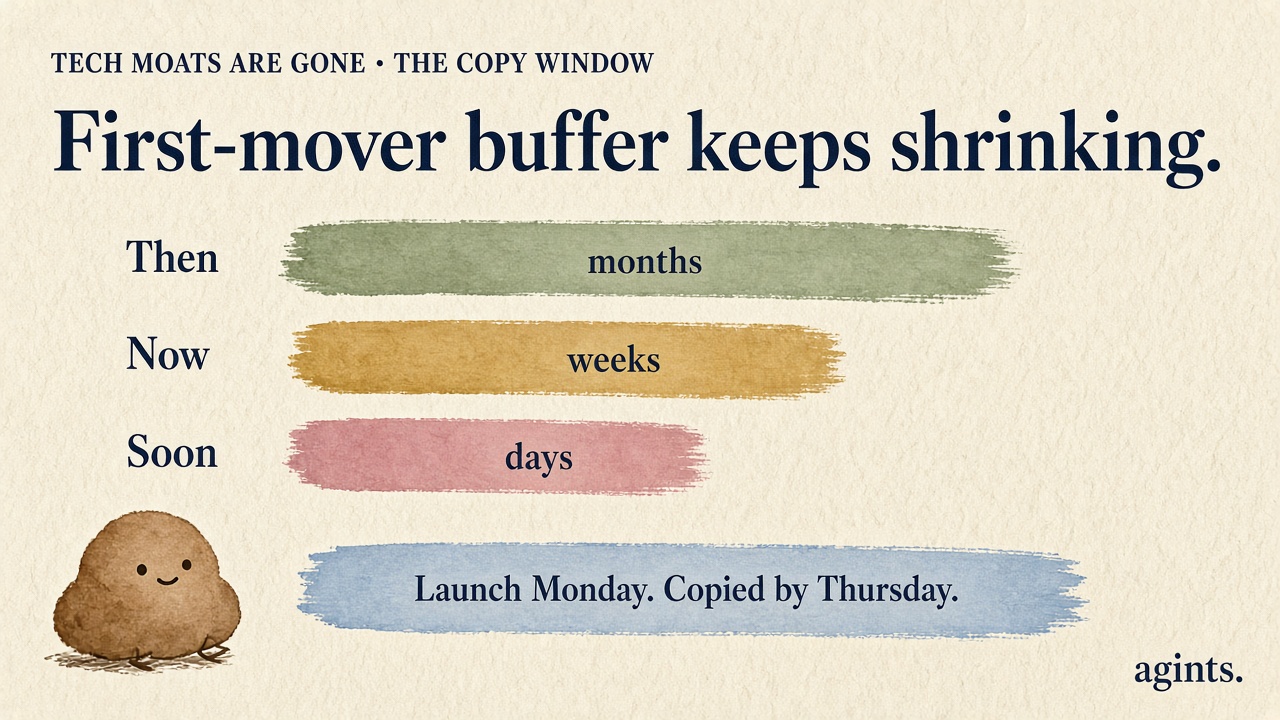
The copy window keeps shrinking
You can see it most clearly with the AI model houses. They have basically unlimited capability and computing horsepower, and they use it.
OpenAI showed off its Decisions API about two weeks after Jev launched. They came out with Dots about seven weeks after Grok Bot was released.
It’s only going to get faster. The buffer you get from being first keeps shrinking, and so does any moat you can protect with speed to market. In one to two years I can see someone releasing an incredible new breakthrough on Monday, and by Wednesday or Thursday one of the model houses has spun up a competitor. Randomly. By coincidence, of course.
Spray and pray
Right now the big AI players are spraying and praying everywhere to get maximum traction and a foothold on everything.
Look at how OpenAI approached Dots with ChatGPT Space. They’re trying to take the whole workflow and have all of it happen inside their AI. They’re challenging places like Slack, Asana and Monday, and you can see all of it. And from where I sit, Dots looks a lot like a run at SpaceXAI’s agent and orchestration framework.
As soon as something comes out, it gets copied. Being the only player in the market buys you a few weeks at most right now, and that’s heading toward days.
That puts more and more weight on sales, the ability to convert, and the ability to maneuver.
Shipping isn’t adoption
The default now is that you can spray and pray software and new features fast. That doesn’t mean your audience converts. It doesn’t mean they understand how to integrate it or implement it.
So you end up with two buckets.
Company A spits out a lot of code, a lot of features, a bunch of stuff, and says, “Hey, here it is. Good luck using it. We dropped a demo video so you can get excited.” There’s very little follow-up, no implementation team, no real structure behind it.
Company B has refined GTM, refined implementation, and a refined “here, let me show you exactly how to use this.” It’s almost like the Genius Bar at Apple. When you buy something, they literally walk you through setting it up and getting comfortable with it.

Where this ends up
If I had to call the end state, Company A has no refined GTM, no physical infrastructure, and no real connection with the customer past “we released it, and this is it.” They’ll have hundreds of features launched and spun up just because spinning them up costs them next to nothing. It’s a spray and pray game.
The companies that do have GTM architecture and a solid sales foundation, the ones that at least show you digitally how to implement something and get better with it, will see higher adoption. You’ll see it on socials like X. Why? Because it’s like having engineers teach people day to day how to use these things. More than anything, they’re maneuvering in the background to make that software or that feature more useful to you.
Here’s a good example. Elon basically said: we know Grok Bot has some limitations because of the model. So we’re going to make Grok Bot so sticky to use by changing the backend to give you the best model for the task you need, whether that’s Opus 5.5 or another model. If it’s better for that thing, and we can give it to you so you get a better experience, just stay on Grok Bot.
Important note regarding Grok @Bot:
Going forward, @SpaceX will use the best back end model for any given task, including Claude Opus 5.5, MidJourney, Suno and other leading APIs.
Whatever is most likely to give you the best outcome.
That makes a lot of sense.
What you see from other companies is, “Hey, we’ve got this new feature, check it out. We put three engineers on a quick three-minute video to show you how to use it.” After that, good luck. They’re on to the next big build. It’s almost like their ethos is being a forever vibe coding company, with no physical sales structure to actually teach people how to implement anything.
That’s a big difference.
Someone has to teach it
Tech has turned into a commodity. The model houses have practically infinite computing power. They can spin up features all day long, and they can copy each other all day long.
But eventually someone has to say: we need to build infrastructure to show people how to use this. Show them how the technology and the features are changing. Show them how it’s going to make a real difference in their life, past a three-minute video.
That’s the dynamic I’m watching. It’s going to separate the tech houses that just ship from the ones willing to stand up real sales teams and real infrastructure. Customers want an ongoing touch point that answers one question: how does this make things better for me?
That’s going to be a clear differentiator.
Who wins
Sales teams win. GTM wins. So does anybody who can actually ship a product and sell it. And if you have strong AI agent skills and you can sell, you’ll be able to call your own shots.
A lot of these companies are going to realize they’re spinning up features that aren’t really going anywhere. What they need is forward deployed engineers. Instead of putting them inside one multi-billion-dollar corporation, they need them in digital form, so thousands of users can learn how to use these tools.
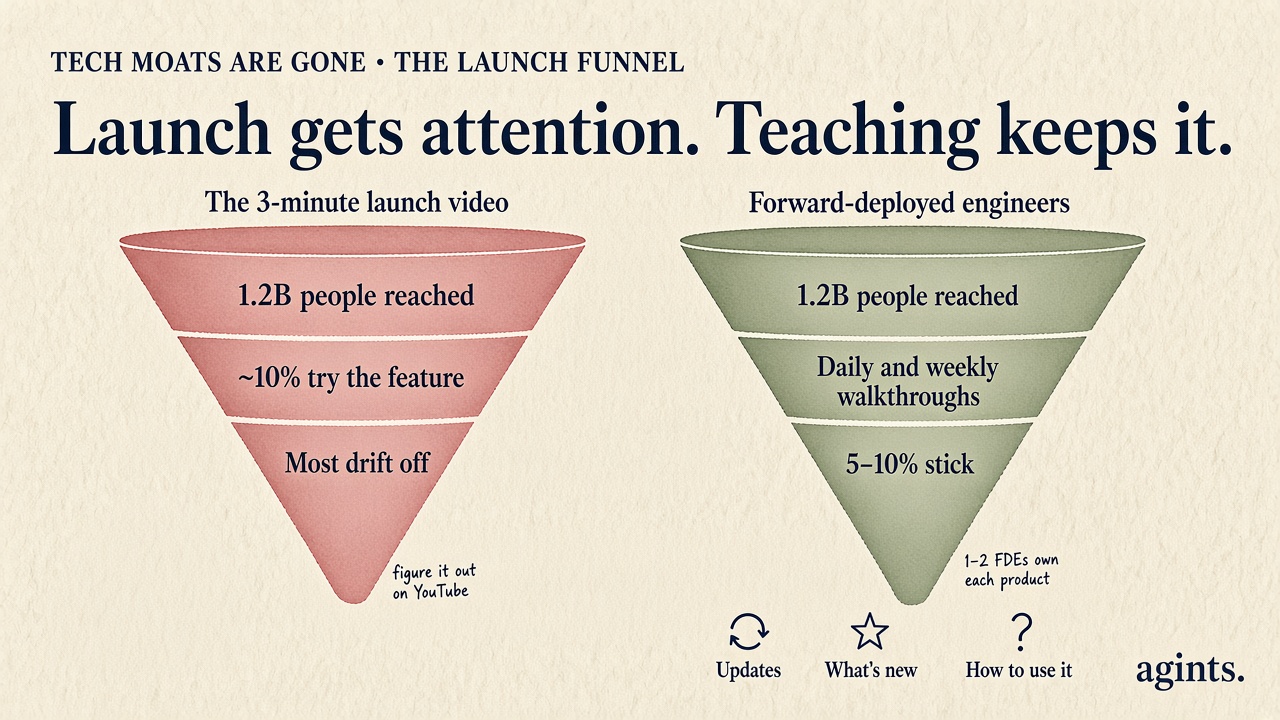
Picture a launch as a funnel. At the top, you’re putting a new feature in front of 1.2 billion people. Your three-minute launch video might get 10% of them to try it. Fine. The video did its job. But most of those people drift off, left to figure it out on YouTube, where the quality is all over the place and they get frustrated.
Now imagine every product in your catalog — even if you end up with a hundred of them — has one or two forward-deployed engineers who live in the digital space and own it. They teach people how to use it, over and over. As the product evolves, they share the updates, what’s new, and how to use it. If you’re interested in that product, you can count on those videos and those people showing up daily or weekly to walk you through it. My rough math: do that, and 5 to 10% of those 1.2 billion end up sticking.
That goes right back to The Remote Forward Deployed Engineer. That’s the skill set of the future.
A digital secretary that does 40–50% of your busywork — even when your laptop’s closed. See if it’s a fit: agints.com/free
 Mike Rodriguez
CTO
Author: The Agents Are Coming · Agents for Business 101
Mike Rodriguez
CTO
Author: The Agents Are Coming · Agents for Business 101
Get the next one in your inbox → agints.substack.com